
|
You entered: surface
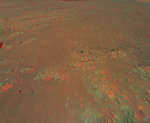 Jezero Crater: Raised Ridges in 3D
7.08.2021
Get out your red-blue glasses and hover over the surface of Mars. Taken on July 24, the 3D color view is from the Mars Ingenuity Helicopter's 10th flight above the Red Planet.
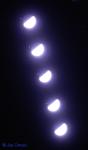 Regulus Occulted
2.08.1999
On May 21, viewed from the continental US, a star winked out as it passed behind the dark limb of the first-quarter Moon. The star, Regulus, is hotter than the sun, about 69 light-years distant, and shines in Earth's skies as the brightest star in the constellation Leo, the Lion.
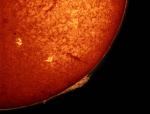 Orange Sun Simmering
29.07.2003
Even a quiet Sun is a busy place. The above image, taken in a single color of light called Hydrogen Alpha, records a great amount of detail of the simmering surface of our parent star.
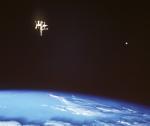 The Moons Of Earth
13.08.1998
While orbiting the planet during their June 1998 mission, the crew of the Space Shuttle Discovery photographed this view of two moons of Earth. Thick storm clouds are visible in the lovely blue planet...
 Eclipsed Moonlight
22.02.2008
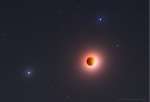
Moon watchers blessed with clear skies over the Americas, Europe, Africa and western Asia enjoyed a total lunar eclipse this week. Catching eclipsed moonlight, astroimager Jerry Lodriguss offers this view of the inspiring celestial...
 Approaching Asteroid Eros
12.02.2001
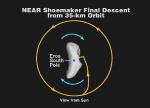
Today, at about 3 pm EST, the first human-made spacecraft is scheduled to touchdown on an asteroid. At an impact speed of 8 kilometers per hour, it is most probable that the robot spacecraft NEAR-Shoemaker will not survive its planned collision with 433 Eros.
 Olympus Mons Volcano on Mars
29.05.2000
Scroll right to virtually climb the largest volcano in the Solar System. Olympus Mons on Mars measures three times higher than Earth's highest mountain, and has a volume over fifty times greater than Earth's largest volcano. The caldera at the top is over 70 kilometers wide.
 Geysers on Triton
5.08.1995
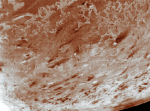
In August of 1989 NASA's Voyager 2 spacecraft passed by Neptune, the most distant of the solar system's gas giant planets. Its encounter with Neptune climaxed with its closest approach to Neptune's largest moon Triton.
 If You Could Stand on Mars
7.02.1996
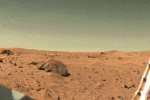
If you could stand on Mars - what would you see? Viking 1 robot landers answered this question in 1976 with pictures like the one shown above. The dark rocks, red soil, and green-tinged sky grace this rendition of a normal Martian afternoon. At the bottom corners of the picture are portions of Viking spacecraft.
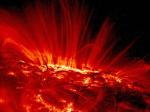 Sunspot Loops in Ultraviolet
10.10.2004
It was a quiet day on the Sun. The above image shows, however, that even during off days the Sun's surface is a busy place. Shown in ultraviolet light, the relatively cool dark regions have temperatures of thousands of degrees Celsius.
|
January February March April May June July August September October |
|||||||||||||||||||||||||||||||||||||||||||||||||