
|
You entered: surface
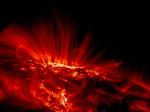 Sunspot Loops in Ultraviolet
11.06.2006
It was a quiet day on the Sun. The above image shows, however, that even during off days the Sun's surface is a busy place. Shown in ultraviolet light, the relatively cool dark regions have temperatures of thousands of degrees Celsius.
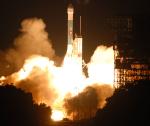 Phoenix Rises Toward Mars
8.08.2007
Can Mars sustain life? To help answer this question, last week NASA launched the Phoenix mission to Mars. In May 2008, Phoenix is expected to land in an unexplored north polar region of Mars that is rich in water-ice.
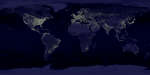 Earth at Night
5.10.2008
This is what the Earth looks like at night. Can you find your favorite country or city? Surprisingly, city lights make this task quite possible. Human-made lights highlight particularly developed or populated areas of the Earth's surface, including the seaboards of Europe, the eastern United States, and Japan.
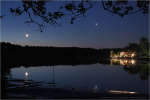 Moon in the Mullica
28.05.2009
Still waters mimic a predawn sky along the eastern horizon in this peaceful scene. The picture was recorded on May 22nd from the banks of the Mullica River, in a forested region known as the Pine Barrens of southern New Jersey on the US east coast.
 APOD: 2024 September 1 Б The Moon Dressed Like Saturn
1.09.2024
Why does Saturn appear so big? It doesn't -- what is pictured are foreground clouds on Earth crossing in front of the Moon. The Moon shows a slight crescent phase with most of its surface visible by reflected Earthlight, known as Da Vinci glow.
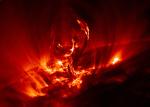 A Solar Filament Lifts Off
25.07.2004
Hot gas frequently erupts from the Sun. One such eruption produced the glowing filament pictured above, which was captured in 2000 July by the Earth-orbiting TRACE satellite. The filament, although small compared...
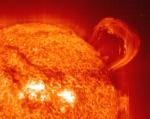 Equinox and Eruptive Prominence
23.09.1999
Today, the Sun crosses the celestial equator and seasons change from Summer to Fall in the north and Winter to Spring in the southern hemisphere. Defined by the Sun's position in sky the event is known as an equinox - the length of daylight is equal to the length of night.
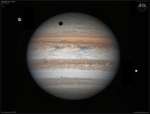 Ganymede s Shadow
25.03.2017
Approaching opposition early next month, Jupiter is offering some of its best telescopic views from planet Earth. On March 17, this impressively sharp image of the solar system's ruling gas giant was taken from a remote observatory in Chile.
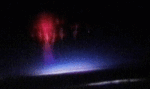 Red Sprite Lightning
11.11.1995
Recently two new types of lightning have been verified: red sprites and blue jets. These atmospheric discharges occur very high in the Earth's atmosphere - much higher than the familiar form of lightning.
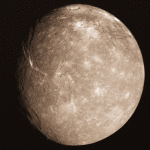 Uranus' Largest Moon: Titania
4.03.1996
Titania's tortured terrain is a mix of valleys and craters. NASA's interplanetary robot spacecraft Voyager 2 passed this moon of Uranus in 1986 and took the above photograph. The photograph was then transmitted back to earth by radio.
|
January February March April May June July August September October |
|||||||||||||||||||||||||||||||||||||||||||||||||