
|
You entered: surface
 The Face on Mars
22.07.1995
This image, showing what looks to be a human face sculpted on the martian surface, was produced using data from NASA's Viking 1 orbiter in 1976. Described in a press release...
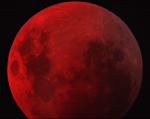 Dark Lunar Eclipse
30.08.2007
The Moon passed close to the center of Earth's shadow on August 28th. Seen best by skywatchers in western North America, and the Pacific region, the resulting total lunar eclipse was a dark one, lasting about 90 minutes.
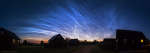 Veins of Heaven
31.07.2014
Transfusing sunlight through a a still dark sky, this exceptional display of noctilucent clouds was captured earlier this month above the island of Gotland, Sweden. From the edge of space, about 80 kilometers above...
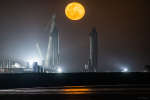 Moon Rising Between Starships
22.02.2021
What's that on either side of the Moon? Starships. Specifically, they are launch-and-return reusable rockets being developed by SpaceX to lift cargo and eventually humans from the Earth's surface into space.
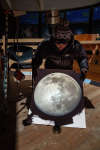 Direct Projection: The Moon in My Hands
28.02.2022
You don't have to look through a telescope to know where it's pointing. Allowing the telescope to project its image onto a large surface can be useful because it dilutes the intense brightness of very bright sources. Such dilution is useful for looking at the Sun, for example during a solar eclipse.
 BZ Cam Bow Shock
28.11.2000
BZ Cam is a binary star system that is not well understood. In most cataclysmic variables, matter from a normal star accumulates on the surface of the companion white dwarf star, eventually causing a nova-like flare as the material becomes hot enough to ignite nuclear fusion.
 Colorful Water Clouds Over Mars
17.04.2001
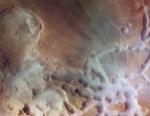
One place where water can be found on Mars is in clouds. In the above picture colorful water clouds are visible just after sunrise in and around a maze of canyons known as Noctis Labyrinthus (the labyrinth of the night).
 Ice Fishing for Cosmic Neutrinos
29.04.2001
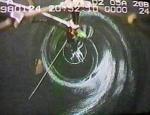
Scientists are melting holes in the bottom of the world. In fact, several holes have been melted near the South Pole, and they are now being used as astronomical observatories. Astronomers with the Antarctic Muon and Neutrino Detector Array (AMANDA) lower into each vertical lake a string knotted with basketball-sized light detectors.
 The Compton Gamma Ray Observatory
11.08.1995
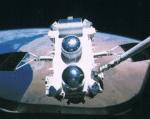
The Compton Gamma Ray Observatory (CGRO) was the most massive instrument ever launched by a NASA Space Shuttle and continues to revolutionize gamma-ray astronomy. This orbiting observatory sees the sky in gamma-ray photons - light so blue humans can't see it.
 M1: Polarization of the Crab
23.11.1995
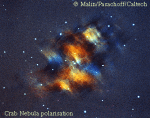
The Crab Nebula resulted from a star that exploded - a supernova. Although the stellar explosion that caused the Crab Nebula was seen over 900 years ago, the nebula itself still expands and shines. Much of the emitted light has been found to be polarized. Light waves with the same polarization vibrate in the same plane.
|
January February March April May June July August September October |
|||||||||||||||||||||||||||||||||||||||||||||||||