
|
You entered: surface
 A Wind From The Sun
17.02.1997
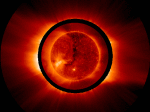
A wind from the Sun blows through our Solar System. The behaviour of comet tails as they flapped and waved in this interplanetary breeze gave astronomers the first hint of its existence. Streaming outward...
 The Largest Rock Known
1.01.1998
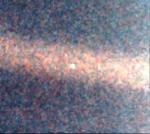
There, that faint dot in the center - that's the largest rock known. It is larger than every known asteroid, moon, and comet nucleus. It is larger than any other rocky planet. (Nobody knows...
 Brown Sun Bubbling
10.01.2000
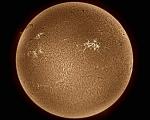
Our Sun may look like all soft and fluffy, but its not. Our Sun is an extremely large ball of bubbling hot gas, mostly hydrogen gas. The above picture was taken in a specific color of light emitted by hydrogen gas called Hydrogen-alpha.
 Young Moon and Sister Stars
28.04.2007
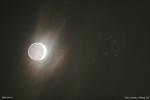
A young crescent Moon shared the western sky with thin clouds and the sister stars of the Pleiades cluster in this early evening skyscape recorded on April 19th. Astronomical images of the well-known Pleiades often show the star cluster's alluring blue reflection nebulae, but they are washed-out here in the clouds and bright moonlight.
 In Green Company: Aurora over Norway
10.12.2017
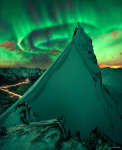
Raise your arms if you see an aurora. With those instructions, two nights went by with, well, clouds -- mostly. On the third night of returning to same peaks, though, the sky not only cleared up but lit up with a spectacular auroral display.
 Mercury in Silhouette
13.11.2019
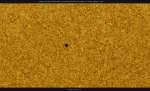
The small, dark, round spot in this solar close up is planet Mercury. In the high resolution telescopic image, a colorized stack of 61 sharp video frames, a turbulent array of photospheric convection cells tile the bright solar surface. Mercury's more regular silhouette still stands out though.
 Ice Volcanoes on Mars
29.06.2001
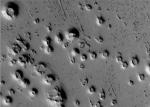
What causes these unusual cone-shaped features on Mars? Spanning an average of only 100 meters at the base, these small cones appear near massive Martian volcanoes such as Olympus Mons. Near the cones are also dry channels and eroded banks.
 Tail Wags of Comet Ikeya Zhang
15.05.2002
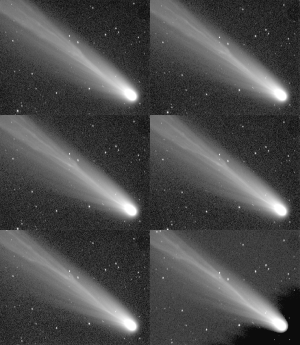
As Comet Ikeya-Zhang approached the Sun two months ago, it developed a complex blue ion tail. The tail was composed of ions that boiled off the nucleus and were pushed away from the Sun by the out-flowing fast-moving particles of the solar wind.
 Venus and the Chromosphere
11.06.2004
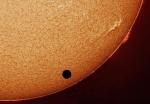
Enjoying the 2004 Transit of Venus from Stuttgart, Germany, astronomer Stefan Seip recorded this fascinating, detailed image of the Sun. Revealing a network of cells and dark filaments against a bright solar disk with spicules and prominences along the Sun's limb, his telescopic picture was taken through an H-alpha filter.
 Transit of Venus Stereogram
17.07.2004
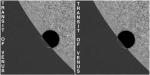
Venus glides in front of an enormous solar disk in these two frames from the TRACE satellite imaging of the inner planet's 2004 transit. Arranged in a "right/left" stereogram, the frames are intended...
|
January February March April May June July August September October |
|||||||||||||||||||||||||||||||||||||||||||||||||