
|
You entered: surface
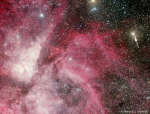 Announcing Nova Carinae 2018
25.03.2018
How bright will Nova Carinae 2018 become? The new nova was discovered only last week. Although novas occur frequently throughout the universe, this nova, cataloged as ASASSN-18fv, is so unusually bright in the skies of Earth that it is now easily visible through binoculars in the southern hemisphere.
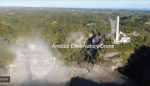 Arecibo Telescope Collapse
9.12.2020
This was one great scientific instrument. Starting in 1963, the 305-meters across Arecibo Telescope in Puerto Rico USA reigned as the largest single-dish radio telescope in the world for over 50 years. Among numerous...
 APOD: 2025 August 30 Б A Two Percent Moon
30.08.2025
A young crescent moon can be hard to see. That's because when the Moon shows it's crescent phase (young or old) it can never be far from the Sun in planet Earth's sky.
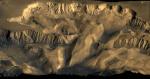 Candor and Ophir Chasmata
18.02.2003
First imaged by the Mariner 9 spacecraft, Valles Marineris, the grand canyon of Mars, is a system of enormous depressions called chasmata that stretch some 4,000 kilometers along the Martian equator. Looking north...
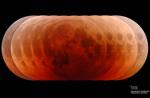 Pumpkin Moon
30.10.2004
Does this look familiar? Red and orange hues haunting the face of the Moon might remind you of the October 27th total lunar eclipse, but the picture is actually a montage of images from a similar lunar spectacle in May of 2003.
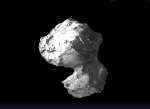 Explore Rosettas Comet
3.10.2016
What would it be like to fly around a comet nucleus? To find out, just wait for your WebGL-compatible browser to load a detailed digital model of Comet 67P and then -- go exploring! With...
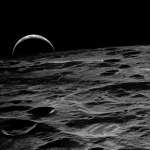 Apollo 14 Heads for Home
1.02.2020
When leaving lunar orbit in February 1971, the crew of Apollo 14 watched this Earthrise from their command module Kittyhawk. With Earth's sunlit crescent just peaking over the lunar horizon, the cratered terrain in the foreground is along the lunar farside.
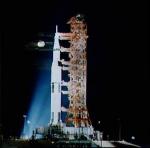 The Last Moon Shot
17.06.2000
In 1865 Jules Verne predicted the invention of a space capsule that could carry people. In his science fiction story "From the Earth to the Moon", he outlined his vision of a cannon in Florida so powerful that it could shoot a "Projectile-Vehicle" carrying three adventurers to the Moon.
 An Apollo 12 Panorama
2.01.2004
The Apollo 12 mission was the second ever to land humans on the Moon. The mission was dedicated to studying the Moon, developing techniques, and developing instruments that could be used in future lunar landings.
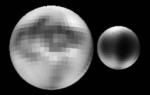 Mysterious Pluto and Charon
8.07.1998
Pluto is the only planet in our Solar System remaining unphotographed by a passing spacecraft. Distant Pluto and its moon Charon therefore remain somewhat mysterious. In addition to direct imaging by the Hubble Space...
|
January February March April May June July August September October |
|||||||||||||||||||||||||||||||||||||||||||||||||