
|
You entered: surface
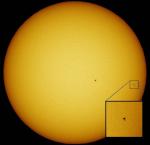 ISS and Discovery Transit the Sun
29.07.2005
That large sunspot near the right edge of the Sun is actually not a sunspot at all. It's the International Space Station (ISS) docked with the Space Shuttle Discovery on mission STS-114.
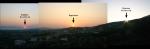 Sunrise by Season
21.12.2005
Does the Sun always rise in the same direction? No. As the seasons change, the direction toward the rising Sun will change, too. The Sun will always rise and set furthest to the south during the day of Winter Solstice, and furthest to the north during Summer Solstice.
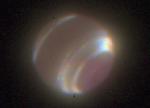 Neptune through Adaptive Optics
18.02.2000
From the Earth's surface, Neptune usually appears as a fuzzy blotch. The blurring effects of the Earth's atmosphere deny clearer images. By distorting mirrors in the telescope itself in time with the changing atmosphere, however, these effects can be greatly reduced.
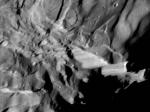 Verona Rupes: Tallest Known Cliff in the Solar System
23.07.2007
Could you survive a jump off the tallest cliff in the Solar System? Quite possibly. Verona Rupes on Uranus' moon Miranda is estimated to be 20 kilometers deep -- ten times the depth of the Earth's Grand Canyon.
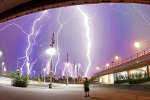 Lightning Over Athens
20.07.2010
Have you ever watched a lightning storm in awe? Join the crowd. Oddly, nobody knows exactly how lightning is produced. What is known is that charges slowly separate in some clouds causing rapid electrical discharges (lightning), but how electrical charges get separated in clouds remains a topic of much research.
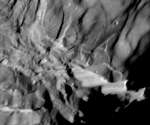 Verona Rupes: Tallest Known Cliff in the Solar System
4.04.2011
Could you survive a jump off the tallest cliff in the Solar System? Quite possibly. Verona Rupes on Uranus' moon Miranda is estimated to be 20 kilometers deep -- ten times the depth of the Earth's Grand Canyon.
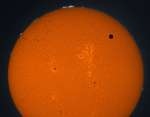 Venus Transit 2012
7.06.2012
Occurring in pairs separated by over a hundred years, there have now been only eight transits of Venus since the invention of the telescope in 1608. The next will be in December of 2117.
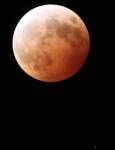 Moons at Opposition
10.10.2014
From the early hours of October 8, over the Santa Cruz Mountains near Los Gatos, California, the totally eclipsed Moon shows a range of color across this well-exposed telescopic view of the lunar eclipse.
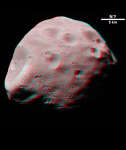 Stereo Phobos
6.08.2022
Get out your red/blue glasses and float next to Phobos, grooved moon of Mars! Captured in 2004 by the High Resolution Stereo Camera on board ESA's Mars Express spacecraft, the image data was recorded at a distance of about 200 kilometers from the martian moon.
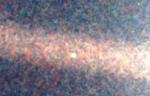 The Largest Rock Known
2.01.2000
There, that faint dot in the center - that's the largest rock known. It is larger than every known asteroid, moon, and comet nucleus. It is larger than any other rocky planet. (Nobody knows...
|
January February March April May June July August September October |
|||||||||||||||||||||||||||||||||||||||||||||||||