
|
You entered: surface
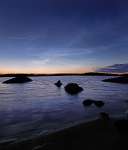 Clouds Near the Edge of Space
22.08.2012
Noctilucent or night-shining clouds lie near the edge of space. From about 80 kilometers above Earth's surface, the icy clouds can still reflect sunlight even though the Sun itself is below the horizon as seen from the ground.
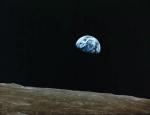 The Millennium that Defined Earth
31.12.2000
When the second millennium began, people generally knew that the Earth was round, but few saw much of it beyond their local village. As the millennium progressed, humans mapped the continents, circumnavigated the globe, and determined the composition of the Earth.
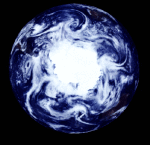 Summer at the South Pole
22.12.1995
December 22 marks the Winter Solstice - the beginning of winter in the Earth's northern hemisphere, and the first day of summer in the south! This view of Earth's southern hemisphere near the beginning of its summer was created using images from the Galileo spacecraft taken during the December 1990 flyby.
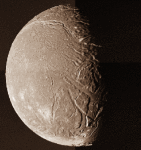 Uranus' Moon Ariel: Valley World
3.03.1996
What formed Ariel's valleys? This question presented itself when Voyager 2 passed this satellite of Uranus in January 1986. Speculation includes that heating caused by the ancient tides of Uranus caused moonquakes and massive shifting of the moon's surface.
 Mars Pathfinder's Landing Site
24.07.1997
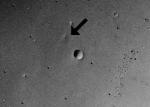
Where is Mars Pathfinder? Follow the arrow in the above picture taken by the Viking Orbiter in 1976. From the surface Mars appears covered with rocks, but from orbit Mars appears covered with craters. However, several familiar features are visible in this photograph.
 At The Suns Edge
20.08.1999
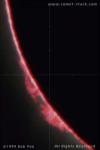
This dramatic set of prominences looms beyond the edge of the sun. The image was captured by astrophotographer Bob Yen as he stood in the moon's shadow near Bagdere, Turkey on August 11 for the millennium's last total solar eclipse.
 Uranus' Moon Miranda
24.12.1995
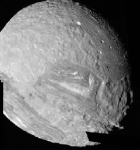
NASA's robot spacecraft Voyager 2 passed the planet Uranus and its moons in 1986. While the cloud tops of Uranus proved to be rather featureless, the surface of Miranda, the innermost of Uranus' large moons, showed several interesting features.
 Gamma Ray Crab, Geminga
24.06.1995
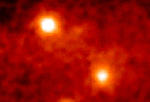
What if you could "see" in gamma-rays? If you could, these two spinning neutron stars or pulsars would be among the brightest objects in the sky. This computer processed image shows the Crab Nebula pulsar (below and right of center) and the Geminga pulsar (above and left of center) in the "light" of gamma-rays.
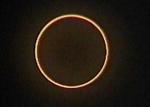 An Annular Eclipse of the Sun
24.08.1998
An annular eclipse of the Sun was visible in parts of the Eastern Hemisphere on Saturday. The above picture was taken at that time by a video camera in Mersing on the East Coast of Malaysia and emailed to APOD yesterday from an internet cafe in Kuala Lumpur.
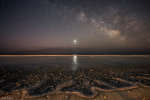 A View from the Zone
7.03.2014
Brilliant Venus and the central Milky Way rise in the early morning hours of March 1 in this sea and skyscape. The scene looks out from a beach at Sea Isle City, New Jersey, USA, planet Earth.
|
January February March April May June July August September October |
|||||||||||||||||||||||||||||||||||||||||||||||||