
|
You entered: constellation
 Sirius: The Brightest Star in the Night
11.06.2000
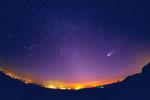
Sirius is the brightest star in the night sky. Sirius is visible on the far left of the above photograph, to the left of the constellation of Orion and Comet Hale-Bopp. Intrinsically, Sirius is over 20 times brighter than our Sun and over twice as massive.
 APOD: 2025 October 28 Б NGC 6995: The Bat Nebula
27.10.2025
Can you see the bat? It haunts this cosmic close-up of the eastern Veil Nebula. The Veil Nebula itself is a large supernova remnant, the expanding debris cloud from the death explosion of a massive star.
 Deep Auriga
4.03.2010
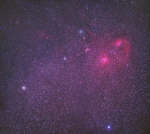
The plane of our Milky Way Galaxy runs right through Auriga, the Charioteer. A good part of the ancient northern constellation's rich collection of nebulae and star clusters is featured in this expansive, 10 degree wide skyscape. Bright star Elnath lies near the bottom right, linking Auriga to another constellation, Taurus, the Bull.
 The Annotated Galactic Center
26.09.2019
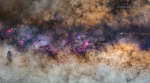
The center of our Milky Way galaxy can be found some 26,000 light-years away toward the constellation Sagittarius. Even on a dark night, you can't really see it though. Gaze in that direction, and your sight-line is quickly obscured by intervening interstellar dust.
 APOD: 2025 November 5 Б Spiral Galaxy NGC 3370 from Hubble
4.11.2025
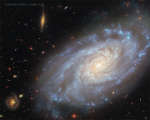
Is this what our own Milky Way Galaxy looks like from far away? Similar in size and grand design to our home Galaxy (although without the central bar), spiral galaxy NGC 3370 lies about 100 million light-years away toward the constellation of the Lion (Leo).
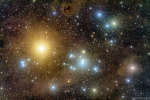 The Hyades Star Cluster
21.01.2020
It is the closest cluster of stars to the Sun. The Hyades open cluster is bright enough to have been remarked on even thousands of years ago, yet is not as bright or compact as the nearby Pleiades (M45) star cluster.
 APOD: 2025 December 15 Б Gemini Meteors over Snow Capped Mountains
14.12.2025
Where are all of these meteors coming from? In terms of direction on the sky, the pointed answer is the constellation of Gemini. That is why the major meteor shower in December is known as the Geminids -- because shower meteors all appear to come from a radiant toward Gemini.
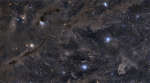 A Dark and Dusty Sky
21.05.2015
In the dusty sky toward the constellation Taurus and the Orion Arm of our Milky Way Galaxy, this broad mosaic follows dark and faint reflection nebulae along the region's fertile molecular cloud.
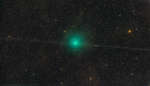 APOD: 2026 July 17 Б The Dust Trail of Comet Tempel 2
16.07.2026
Comet 10P/Tempel 2 orbits the Sun once every 5.4 years. Currently visible in binoculars or small telescopes toward the constellation Capricornus, the periodic comet is captured in this sharp telescopic image from July 11 sporting a bright nuclear region and pretty greenish coma.
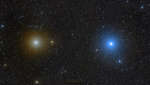 Gemini Stars Pollux and Castor
15.05.2017
Who are the twins of Gemini? It terms of astronomical objects, the famous constellation is dominated by two bright stars: Pollux (left) and Castor (right). Pictured, the two stars stand out because they are so bright, so close together both in angle and brightness, but so different in color.
|
January February March April May June July August September October |
|||||||||||||||||||||||||||||||||||||||||||||||||