
|
You entered: constellation
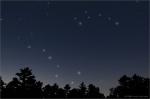 The Big Dipper
8.01.2007
Do you see it? This common question frequently precedes the rediscovery of one of the most commonly recognized configurations of stars on the northern sky: the Big Dipper. This grouping of stars is one of the few things that has likely been seen, and will be seen, by every generation.
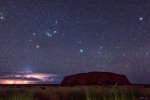 Lightning and Orion Beyond Uluru
11.05.2021
What's happening behind Uluru? A United Nations World Heritage Site, Uluru is an extraordinary 350-meter high mountain in central Australia that rises sharply from nearly flat surroundings. Composed of sandstone, Uluru has slowly formed over the past 300 million years as softer rock eroded away.
 APOD: 2024 June 10 Б Sh2 132: The Lion Nebula
10.06.2024
Is the Lion Nebula the real ruler of the constellation Cepheus? This powerful feline appearing nebula is powered by two massive stars, each with a mass over 20 times greater than our Sun. Formed...
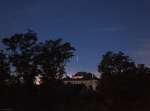 Perseid over Albrechtsberg Castle
9.08.2013
Medieval Albrechtsberg castle is nestled in trees near the northern bank of the river Pielach and the town of Melk, Austria. In clearing night skies on August 12, 2012 it stood under constellations of the northern summer, including Aquarius, Aquila, and faint, compact Delphinus (above and right of center) in this west-looking skyview.
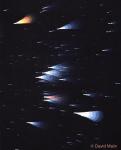 Orion's Star Colors
2.12.1996
What determines a star's color? Its temperature. Red stars are cool, with temperatures of around 3,000 degrees Kelvin (K), while blue stars are hotter and can have temperatures over 30,000 degrees K. Our own lovely yellow Sun's temperature is a comforting 6,000 degrees K.
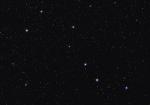 The Big Dipper Cluster
17.03.2006
A well-known asterism in northern skies, The Big Dipper is easy to recognize even when viewed upside down. Part of the larger constellation of Ursa Major, the bright dipper stars above are named (left to right along the dipper) Dubhe, Merak, Phecda, Megrez, Alioth, Mizar/Alcor, and Alkaid.
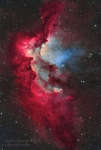 APOD: 2025 October 8 Б NGC 7380: The Wizard Nebula
8.10.2025
What powers are being wielded in the Wizard Nebula? Gravitation strong enough to form stars, and stellar winds and radiations powerful enough to create and dissolve towers of gas. Located only 8,000 light years away, the Wizard nebula, featured here, surrounds a developing open star cluster NGC 7380.
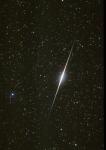 Iridium 52: Not A Meteor
22.10.1999
While hunting for meteors in the night sky above the White Mountains near Bishop, California, astrophotographer James Young instead captured this brilliant celestial apparition. Recorded near twilight on August 13, the bright streak is not the flash of a meteor trail but sunlight glinting from a satellite.
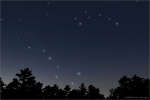 The Big Dipper
21.04.2013
Do you see it? This common question frequently precedes the rediscovery of one of the most commonly recognized configurations of stars on the northern sky: the Big Dipper. This grouping of stars is one of the few things that has likely been seen, and will be seen, by every generation.
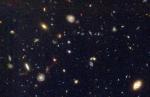 A Deep Field In The Southern Sky
2.12.1998
This new deep view of the cosmos is the sequel to the 1995 hit Hubble Space Telescope Deep Field. Billed as the Hubble Deep Field South, it was produced by pointing the space telescope toward a patch of sky in the southern constellation Tucana.
|
January February March April May June July August September October |
|||||||||||||||||||||||||||||||||||||||||||||||||