
|
You entered: constellation
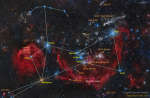 Official Star Names for Orion
3.12.2016
Familiar stars in Orion and constellations across the sky now have official names. Over the past year, the International Astronomical Union, the only body officially tasked with naming stars, approved names already in common use for 227 of the brightest stars, including the most famous stars on the sky Sirius, Polaris, and Betelgeuse.
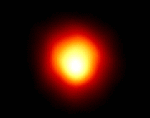 Betelgeuse, Betelgeuse, Betelgeuse
21.01.1996
Betelgeuse (sounds a lot like "beetle juice"), a red supergiant star about 600 lightyears distant, is shown here in this Hubble Space Telescope image which represents the first direct picture of the surface of a star other than the Sun.
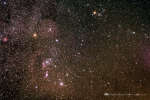 The Hunter, the Bull, and Lovejoy
13.01.2015
Heading north, Comet Lovejoy (C/2014 Q2) is putting on its best show for comet watchers now, with moonlight absent from mid-January's early evening skies. An easy binocular target and just visible to the unaided eye from dark sites, the comet sweeps across the constellation Taurus the Bull in this deep night skyscape.
 APOD: 2023 December 17 Б Geminids over Chinas Nianhu Lake
16.12.2023
Where are all of these meteors coming from? In terms of direction on the sky, the pointed answer is the constellation of Gemini. That is why the major meteor shower in December is known as the Geminids -- because shower meteors all appear to come from a radiant toward Gemini.
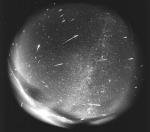 Leonids from Leo
3.11.2001
Is Leo leaking? Leo, the famous sky constellation visible on the left of the above all-sky photograph, appears to be the source of all the meteors seen in 1998's Leonids Meteor Shower. That...
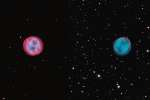 Northern and Southern Owls
6.05.2010
Captured in colorful telescopic portraits, two cosmic owls glare back toward planet Earth in this intriguing comparison of planetary nebulae. On the left is M97 in the constellation Ursa Major, also known in the northern hemisphere as the Owl Nebula.
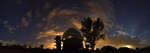 Moon Rays over Byurakan Observatory
26.09.2008
On September 7th, the first quarter Moon and passing clouds contributed to a dramatic night sky over the Byurakan Astrophysical Observatory. This panoramic view begins at the left looking toward the eastern horizon and the rising stars of the constellation Perseus.
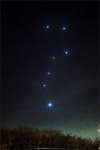 The Big Dipper Enhanced
16.03.2015
Do you see it? This common question frequently precedes the rediscovery of one of the most commonly recognized configurations of stars on the northern sky: the Big Dipper. This grouping of stars is one of the few things that has likely been seen, and will be seen, by every human generation.
 Leonid Meteors Through Orion
27.11.2022
Where will the next meteor appear? Even during a meteor shower, it is practically impossible to know. Therefore, a good way to enjoy a meteor shower is to find a place where you can sit comfortably and monitor a great expanse of dark sky.
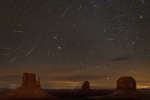 Geminids and the Mittens
24.12.2022
Asteroid 3200 Phaethon's annual gift to planet Earth always arrives in December. Otherwise known as the Geminid meteor shower, the source of the meteroid stream is dust shed along the orbit of the mysterious asteroid.
|
January February March April May June July August September October |
|||||||||||||||||||||||||||||||||||||||||||||||||