
|
You entered: constellation
 The Milky Way Near the Southern Cross
18.06.2000
This breathtaking patch of sky would be above you were you to stand at the South Pole of the Earth. Just above and to the right of this photograph's center are the four stars that mark the boundaries of the famous Southern Cross.
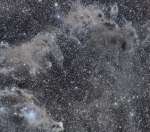 The Chameleon's Dark Nebulae
15.07.2009
The Chameleon is a small constellation near the south celestial pole. Boasting no bright stars, it blends inconspicuously with the starry southern sky. But, taken in dark skies over Namibia, this image reveals a stunning aspect of the shy constellation -- a field of dusty nebulae and colorful stars.
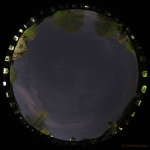 A Spring Sky Over Hirsau Abbey
6.05.2009
What's in the sky tonight? When strolling outside just after sunset, even if just going out to your car, a casual glance upwards can reveal a beautiful night sky also seen by many people across the Earth.
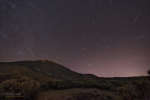 Quadrantids
9.01.2019
Named for a forgotten constellation, the Quadrantid Meteor Shower is an annual event for planet Earth's northern hemisphere skygazers It usually peaks briefly in the cold, early morning hours of January 4. The shower's radiant on the sky lies within the old, astronomically obsolete constellation Quadrans Muralis.
 A Dark Seahorse in Cepheus
7.11.2025
Spanning light-years, this suggestive shape known as the Seahorse Nebula floats in silhouette against a rich background of stars and glowing hydrogen gas. Seen toward the royal northern constellation of Cepheus, the dusty, dark nebula is part of a Milky Way molecular cloud some 1,200 light-years distant.
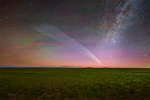 APOD: 2025 December 30 Б An Artificial Comet
30.12.2025
Yes, but can your comet tail do this? No, and what you are seeing is not the tail of a comet. The picture features a cleverly overlayed time-lapse sequence of a group of satellites orbiting Earth together in June.
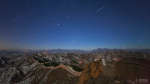 Quadrantids over the Great Wall
3.01.2020
Named for a forgotten constellation, the Quadrantid Meteor Shower is an annual event for planet Earth's northern hemisphere skygazers The shower's radiant on the sky lies within the old, astronomically obsolete constellation Quadrans Muralis. That location is not far from the Big Dipper, at the boundaries of the modern constellations Bootes and Draco.
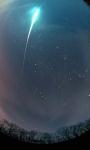 A Leonid Bolide Over Kansas
25.11.1998
The 1998 Leonid Meteor Shower featured many bright events. Extremely bright meteors, known as bolides or fireballs, can briefly glow brighter than the full moon. Pictured above is a Leonid bolide caught during a five-minute, wide-angle exposure. The bolide was so bright it lit up the surrounding area, making otherwise dark trees visible.
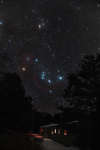 Northern Winter Night
25.12.2020
Orion always seems to come up sideways on northern winter evenings. Those familiar stars of the constellation of the Hunter are caught above the trees in this colorful night skyscape. Not a star at all but still visible to eye, the Great Nebula of Orion shines below the Hunter's belt stars.
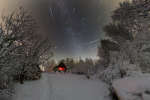 A Cold December Night
22.12.2018
They say Orion always comes up sideways, and he does seem to on this cold December night. The bright stars of the familiar northern winter constellation lie just above the snowy tree tops surrounding a cozy cottage near the town of Ustupky in the Czech Republic.
|
January February March April May June July August September October |
|||||||||||||||||||||||||||||||||||||||||||||||||