
|
You entered: dark
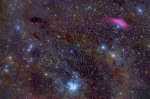 Comet PanSTARRS is near the Edge
16.02.2018
The comet PanSTARRS, also known as the blue comet (C/2016 R2), really is near the lower left edge of this stunning, wide field view recorded on January 13. Spanning nearly 20 degrees on the sky, the cosmic landscape is explored by well-exposed and processed frames from a sensitive digital camera.
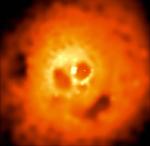 The Perseus Cluster s X Ray Skull
31.10.2000
This haunting image from the orbiting Chandra Observatory reveals the Perseus Cluster of Galaxies in x-rays, photons with a thousand or more times the energy of visible light. Three hundred twenty million light-years distant, the Perseus Cluster contains thousands of galaxies, but none of them are seen here.
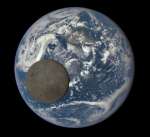 Full Earth, Full Moon
7.08.2015
The Moon was new on July 16. Its familiar nearside facing the surface of planet Earth was in shadow. But on that date a million miles away, the Deep Space Climate Observatory (DSCOVR) spacecraft's Earth Polychromatic Imaging Camera (EPIC) captured this view of an apparently Full Moon crossing in front of a Full Earth.
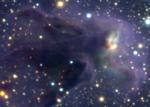 M16: Infrared Star Hunt
4.01.2002
The head of an interstellar gas and dust cloud is shown here in false-color, a near-infrared view recorded by astronomers hunting for stars within M16's Eagle Nebula. Made famous in a 1995 Hubble...
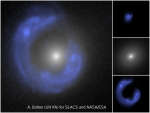 SDSSJ1430: A Galaxy Einstein Ring
28.07.2008
What's large and blue and can wrap itself around an entire galaxy? A gravitational lens mirage. Pictured above on the left, the gravity of a normal white galaxy has gravitationally distorted the light from a much more distant blue galaxy.
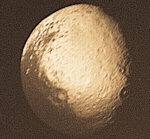 Iapetus: Saturn's Disappearing Moon
15.10.1995
Iapetus has an unusual surface, one half of which is very dark, the other half very light. This caused it's discoverer Cassini to remark that Iapetus could only be seen when on one side of Saturn but not the other. The reason for the difference between hemispheres is presently unknown.
 Comet Hyakutake's Closest Approach
24.03.1996
The above true color image of Comet Hyakutake was taken the night of March 21/22. Tonight, Comet Hyakutake will make its nearest approach to Earth, closing to a mere 10 million miles as it passes over the planet's Northern Hemisphere.
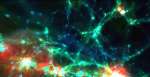 Illustris Simulation of the Universe
23.02.2020
How did we get here? Click play, sit back, and watch. A computer simulation of the evolution of the universe provides insight into how galaxies formed and perspectives into humanity's place in the universe.
 APOD: 2023 December 31 Б Illustris: A Simulation of the Universe
31.12.2023
How did we get here? Click play, sit back, and watch. A computer simulation of the evolution of the universe provides insight into how galaxies formed and perspectives into humanity's place in the universe.
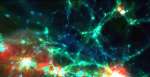 Illustris Simulation of the Universe
12.05.2014
How did we get here? Click play, sit back, and watch. A new computer simulation of the evolution of the universe -- the largest and most sophisticated yet produced -- provides new insight into how galaxies formed and new perspectives into humanity's place in the universe.
|
January February March April May June July August September |
|||||||||||||||||||||||||||||||||||||||||||||||||