
|
You entered: dark
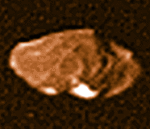 Jupiter's Moon Amalthea
3.11.1995
Amalthea is Jupiter's fifth largest moon, much smaller than the four Galilean satellites Io, Europa, Ganymede, and Callisto. The orbit of Amalthea is inside of these moons, and with its long axis always pointing toward Jupiter. It's dark surface color is probably due to sulfur being expelled from Io.
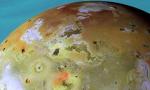 Sizzling Io
6.07.1998
What's cooking on Io? This active moon of Jupiter is marked with volcanoes spewing lava that is now known to be hotter than any lava on Earth. Above is the highest resolution color-enhanced image yet composed of the most active surface in our Solar System. Features as small as three kilometers are visible.
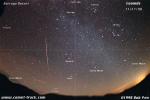 An Annotated Leonid
30.11.1998
The 1998 Leonids Meteor Shower was perhaps the most photographed meteor event in history. Patient observers saw bright meteors streak across dark skies every few minutes, frequently leaving fading trails stretching across the sky. High above the Anza-Borrego Desert, a meteor was photographed streaking up from the radiant constellation of the Leonids: Leo.
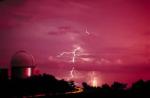 Telescope with Lightning
19.01.1999
Telescopes are not very useful during lightning storms. Nevertheless, with lightning illuminating a dark landscape, the picturesque dome of the famous Kitt Peak 2.1-meter Telescope makes for a dramatic photograph. A passing car created the red and yellow streaks visible in the foreground.
 Neptune's Moon Proteus
4.11.1995
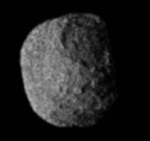
Proteus is the second largest moon of Neptune behind the mysterious Triton. Proteus was discovered only in 1982 by the Voyager 2 spacecraft. This is unusual since Neptune has a smaller moon - Nereid - which was discovered 33 years earlier from Earth.
 Look Up Together
24.04.2020
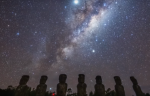
Watch this video. In only a minute or so you can explore the night skies around planet Earth through a compilation of stunning timelapse sequences. The presentation will take you to sites in the United States, Germany, Russia, Iran, Nepal, Thailand, Laos and China.
 The Wind on Mars
12.01.1999
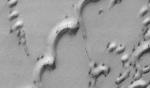
Wind erosion has been discovered on Mars. Pictures of regions surrounding the north polar cap show sand dunes covered in frost. In places, however, this frost has been eroded to uncover the dark sand underneath.
 The Sky Towards Sagittarius
7.09.1998
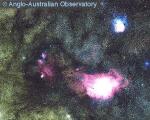
A variety of stars and nebulae can be found towards the constellation of Sagittarius. Dense fields of stars laced with dark lanes of dust crowd this region only a few degrees from the center of our Galaxy.
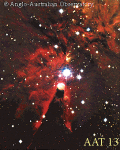 A Mysterious Cone Nebula
1.03.1996
Sometimes the simplest shapes are the hardest to explain. For example, the origin of the mysterious cone-shaped region located just below the center of the above picture remains a mystery. The dark region clearly contains much dust which blocks light from the emission nebula and open cluster NGC 2264 behind it.
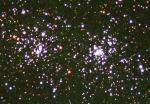 NGC 869 & NGC 884: A Double Open Cluster
29.01.1997
Most star clusters are singularly impressive. But open clusters NGC 869 and NGC 884 are doubly impressive. Also known as "h and chi Persei", this rare double cluster, shown above, is bright enough to be seen from a dark location without even binoculars.
|
January February March April May June July August September |
|||||||||||||||||||||||||||||||||||||||||||||||||