
|
You entered: dark
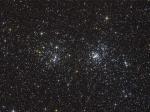 NGC 869 and NGC 884: A Double Open Cluster
11.10.2005
Most star clusters are singularly impressive. Open clusters NGC 869 and NGC 884, however, are doubly impressive. Also known as "h and chi Persei", this unusual double cluster, shown above, is bright enough to be seen from a dark location without even binoculars.
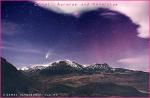 Big Sky Comet
21.04.1997
On April 17th, "Big Sky" country sure lived up to its name. The dark skies over the US states of Wyoming, Montana and the Dakotas were quite busy, as shown by this photograph featuring Comet Hale-Bopp. In the foreground is the Absaroka Mountain Range in Wyoming, lit by reflected moonlight.
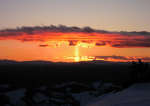 Pillar at Sunset
6.03.2010
Reddened light from the setting Sun illuminates the cloud banks hugging this snowy, rugged terrain. Inspiring a moment of quiet contemplation, the sunset scene included a remarkable pillar of light that seemed to connect the clouds in the sky with the mountains below.
 Night on a Spooky Planet
29.10.2017
What spooky planet is this? Planet Earth of course, on a dark and stormy night in 2013 at Hverir, a geothermally active area along the volcanic landscape in northeastern Iceland. Geomagnetic storms produced...
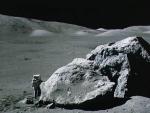 Apollo 17: Boulder on the Moon
5.09.1997
Twenty five years ago humans roamed the Moon. Pictured here during the last moon landing, scientist-astronaut Harrison Schmitt was photographed standing next to a huge, split boulder. Apollo 17 was one of six missions that landed humans on the moon and returned them safely.
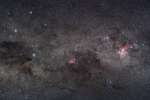 The Southern Cross in a Southern Sky
7.07.2008
This breathtaking patch of sky would be above you were you to stand at the South Pole of the Earth. On the upper left of this image are the four stars that mark the boundaries of the famous Southern Cross.
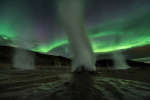 Night on a Spooky Planet
31.10.2013
What spooky planet is this? Planet Earth of course, on the dark and stormy night of September 12 at Hverir, a geothermally active area along the volcanic landscape in northeastern Iceland. Geomagnetic storms produced...
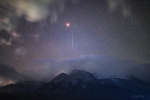 Mars and Meteor over Jade Dragon Snow Mountain
21.11.2020
A brilliant yellowish celestial beacon, Mars still dazzles in the night. Peering between clouds the wandering planet was briefly joined by the flash of a meteor in this moonless dark sky on November 18. The single exposure was taken as the Earth swept up dust from periodic comet Tempel-Tuttle during the annual Leonid Meteor Shower.
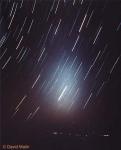 Zodiacal Light
26.08.1997
Sometimes the sky itself seems to glow. Usually, this means you are seeing a cloud reflecting sunlight or moonlight. If the glow appears as a faint band of light running across the whole sky, you are probably seeing the combined light from the billions of stars that compose our Milky Way Galaxy.
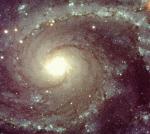 NGC 2997 from VLT
10.03.1999
Add another 8-meter telescope to the list of modern optical telescope giants. Kueyen achieved a first-light photograph of a bright star on March 1, ahead of schedule. The above picture of spiral galaxy...
|
January February March April May June July August September |
|||||||||||||||||||||||||||||||||||||||||||||||||