
|
You entered: distance
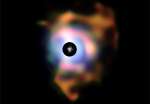 Stardust and Betelgeuse
28.06.2011
An expansive nebula of dust is seen to surround red supergiant star Betegeuse in this remarkable high resolution composite, an infrared VLT image from the European Southern Observatory. Betelgeuse itself is outlined by the small, central red circle. If found in our own solar system its diameter would almost encompass the orbit of Jupiter.
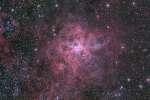 The Cosmic Web of the Tarantula Nebula
17.02.2014
It is the largest and most complex star forming region in the entire galactic neighborhood. Located in the Large Magellanic Cloud, a small satellite galaxy orbiting our Milky Way galaxy, the region's spidery appearance is responsible for its popular name, the Tarantula nebula. This tarantula, however, is about 1,000 light-years across.
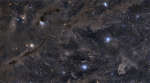 A Dark and Dusty Sky
22.05.2015
In the dusty sky toward the constellation Taurus and the Orion Arm of our Milky Way Galaxy, this broad mosaic follows dark and faint reflection nebulae along the region's fertile molecular cloud.
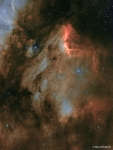 IC 5070: A Dusty Pelican in the Swan
19.11.2016
The recognizable profile of the Pelican Nebula soars nearly 2,000 light-years away in the high flying constellation Cygnus, the Swan. Also known as IC 5070, this interstellar cloud of gas and dust...
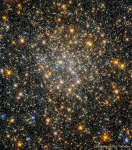 Palomar 6: Globular Star Cluster
19.10.2021
Where did this big ball of stars come from? Palomar 6 is one of about 200 globular clusters of stars that survive in our Milky Way Galaxy. These spherical star-balls are older than our Sun as well as older than most stars that orbit in our galaxy's disk.
 The Great Globular Cluster in Hercules
26.09.2024
In 1716, English astronomer Edmond Halley noted, "This is but a little Patch, but it shows itself to the naked Eye, when the Sky is serene and the Moon absent." Of course...
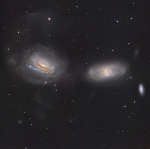 APOD: 2026 May 18 Б Unraveling NGC 3169
18.05.2026
Spiral galaxy NGC 3169 looks to be unraveling like a ball of cosmic yarn. It lies some 70 million light-years away, south of bright star Regulus toward the faint constellation Sextans. Wound up spiral arms are pulled out into sweeping tidal tails as NGC 3169 (left) and neighboring NGC 3166 interact gravitationally.
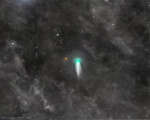 APOD: 2026 August 24 Б Comet 220P in Outburst
24.08.2026
Comet 220P is unexpectedly bright. Normally, periodic Comet 220P/McNaught is so dim that to see it requires a telescope. Two surprising outbursts this year, however, have made it about 20,000 times brighter than usual, so that it is now visible with binoculars and long-duration camera exposures.
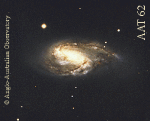 Unusual Spiral Galaxy M66
10.08.1996
Spiral galaxy M66 is largest galaxy in the a group known as the Leo Triplet. M66 is somewhat peculiar because of its asymmetric spiral arms. Usually dense waves of gas, dust, and newly formed stars - called spiral density waves - circle a galactic center and create a symmetric galaxy.
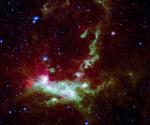 Henize 206: Cosmic Generations
11.03.2004
Peering into a dusty nebula in nearby galaxy the Large Magellanic Cloud, infrared cameras on board the Spitzer Space Telescope recorded this detailed view of stellar nursery Henize 206 filled with newborn stars. The stars appear as white spots within the swirls of dust and gas in the false-color infrared image.
|
January February March April May June July August September October |
|||||||||||||||||||||||||||||||||||||||||||||||||