
|
You entered: distance
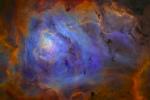 Blue Lagoon
25.08.2006
Stars come and go as you slide your cursor over this engaging image of M8, aka the Lagoon Nebula. Of course, the nebula is itself a star-forming region, but the stars that appear and disappear here include background and foreground stars that by chance lie along the same line of sight.
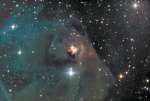 T Tauri and Hind s Variable Nebula
13.12.2007
The orange star centered in this remarkable telescopic skyview is T Tauri, protoytpe of the class of T Tauri variable stars. Nearby it is a dusty yellow cosmic cloud historically known as Hind's Variable Nebula (aka NGC 1555/1554).
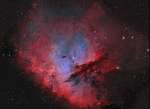 Portrait of NGC 281
25.08.2011
Look through the cosmic cloud cataloged as NGC 281 and it's almost easy to miss stars of open cluster IC 1590. But, formed within the nebula, that cluster's young, massive stars ultimately power the pervasive nebular glow.
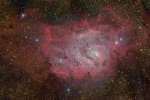 M8: The Lagoon Nebula
17.08.2013
This beautiful cosmic cloud is a popular stop on telescopic tours of the constellation Sagittarius. Eighteenth century cosmic tourist Charles Messier cataloged the bright nebula as M8. Modern day astronomers recognize the Lagoon Nebula as an active stellar nursery about 5,000 light-years distant, in the direction of the center of our Milky Way Galaxy.
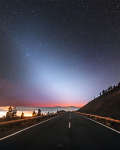 Zodiacal Road
24.07.2019
What's that strange light down the road? Dust orbiting the Sun. At certain times of the year, a band of sun-reflecting dust from the inner Solar System appears prominently just after sunset -- or just before sunrise -- and is called zodiacal light.
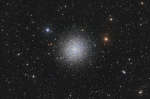 M13: The Great Globular Cluster in Hercules
20.05.2021
In 1716, English astronomer Edmond Halley noted, "This is but a little Patch, but it shews itself to the naked Eye, when the Sky is serene and the Moon absent." Of course...
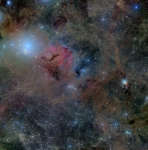 Stardust in Perseus
12.01.2023
This cosmic expanse of dust, gas, and stars covers some 6 degrees on the sky in the heroic constellation Perseus. At upper left in the gorgeous skyscape is the intriguing young star cluster IC 348 and neighboring Flying Ghost Nebula with clouds of obscuring interstellar dust cataloged as Barnard 3 and 4.
 IC 348 and Barnard 3
14.11.2024
A great nebulous region near bright star omicron Persei offers this study in cosmic contrasts. Captured in the telescopic frame the colorful complex of dust, gas, and stars spans about 3 degrees on the sky along the edge of the Perseus molecular cloud some 1000 light-years away.
 The Map Of Eros
26.10.2000
This map of Eros was constructed from a mosaic of images recorded by the NEAR Shoemaker spacecraft, currently orbiting the 40 x 14 x 14 kilometer asteroid. A simple cylindrical projection of an irregularly shaped world, the map's individual images don't always match up at the edges.
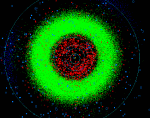 Our Busy Solar System
24.07.2002
Our Solar System is a busy place. Although the major planets get the most press, a swarm of rocks, comets, and asteroids also exist. The above plot shows the placement of known inner Solar System objects on 2002 July 20. The light blue lines indicate the orbits of planets.
|
January February March April May June July August September October |
|||||||||||||||||||||||||||||||||||||||||||||||||