
|
You entered: distance
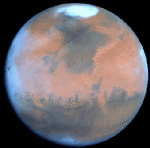 A Halloween Invasion from Mars
31.10.1995
Orson Welles became an instant legend on Halloween in 1938 for his radio dramatization of H.G. Wells' "War of the Worlds". Some listeners who did not realize it was a theatrical production were driven to near panic by this fictional account of invaders from Mars.
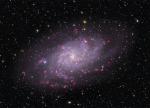 M33: Spiral Galaxy in Triangulum
14.09.2006
The small, northern constellation Triangulum harbors this magnificent face-on spiral galaxy, M33. Its popular names include the Pinwheel Galaxy or just the Triangulum Galaxy. M33 is over 50,000 light-years in diameter, third largest in the Local Group of galaxies after the Andromeda Galaxy (M31), and our own Milky Way.
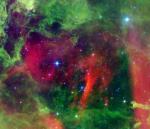 Hot Stars in the Rosette Nebula
26.07.2007
Winds and radiation from massive hot stars in the Rosette Nebula have cleared the natal gas and dust from the center of the nearby star-forming region. They also pose a danger to planet forming disks around young, cooler stars in the neighborhood.
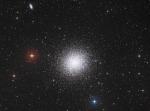 M13: The Great Globular Cluster in Hercules
15.11.2007
M13 is modestly recognized as the Great Globular Cluster in Hercules. A system of stars numbering in the hundreds of thousands, it is one of the brightest globular star clusters in the northern sky.
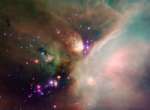 Young Stars in the Rho Ophiuchi Cloud
13.11.2009
Cosmic dust clouds and embedded newborn stars glow at infrared wavelengths in this tantalizing false-color view from the Spitzer Space Telescope. Pictured is of one of the closest star forming regions, part of the Rho Ophiuchi cloud complex some 400 light-years distant near the southern edge of the pronounceable constellation Ophiuchus.
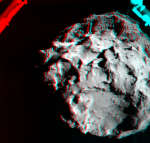 3D 67P
28.11.2014
Get out your red/blue glasses and float next to a comet! The Rosetta mission lander Philae's ROLIS camera snapped the two frames used to create this stereo anaglyph for 3D viewing during...
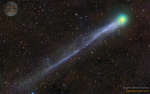 Comet Lovejoy s Tail
16.01.2015
Sweeping north in planet Earth's sky, Comet Lovejoy's greenish coma and blue tinted ion tail stretched across this field of stars in the constellation Taurus on January 13. The inset at the upper left shows the 1/2 degree angular size of the full moon for scale.
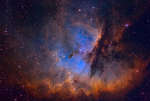 Portrait of NGC 281
4.11.2016
Look through the cosmic cloud cataloged as NGC 281 and you might miss the stars of open cluster IC 1590. Still, formed within the nebula that cluster's young, massive stars ultimately power the pervasive nebular glow.
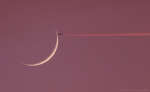 Fly Me to the Moon
17.01.2017
No, this is not a good way to get to the Moon. What is pictured is a chance superposition of an airplane and the Moon. The contrail would normally appear white, but the large volume of air toward the setting Sun preferentially knocks away blue light, giving the reflected trail a bright red hue.
 APOD: 2023 May 3 Б Centaurus A: A Peculiar Island of Stars
3.05.2023
Galaxies are fascinating. In galaxies, gravity alone holds together massive collections of stars, dust, interstellar gas, stellar remnants and dark matter. Pictured is NGC 5128, better known as Centaurus A. Cen A is the fifth brightest galaxy on the sky and is located at a distance of about 12 million light years from Earth.
|
January February March April May June July August September October |
|||||||||||||||||||||||||||||||||||||||||||||||||