
|
You entered: telescope
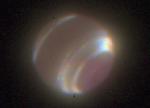 Neptune through Adaptive Optics
18.02.2000
From the Earth's surface, Neptune usually appears as a fuzzy blotch. The blurring effects of the Earth's atmosphere deny clearer images. By distorting mirrors in the telescope itself in time with the changing atmosphere, however, these effects can be greatly reduced.
 3 ATs
3 ATs
4.05.2024
Despite their resemblance to R2D2, these three are not the droids you're looking for. Instead, the enclosures house 1.8 meter Auxiliary Telescopes (ATs) at Paranal Observatory in the Atacama Desert region of Chile.
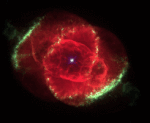 The Cat's Eye Nebula
28.06.1995
Three thousand light years away, a dying star throws off shells of glowing gas. This Hubble Space Telescope image reveals "The Cat's Eye Nebula" to be one of the most complex "planetary nebulae" known.
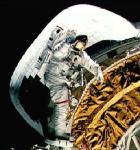 Space Walz
11.02.1997
Astronaut Carl Walz waves at his colleagues from the aft end of the Space Shuttle Discovery's payload bay - during a 1993 spacewalk to evaluate tools, tethers, and a foot restraint slated for use in the first Hubble Space Telescope servicing mission.
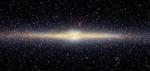 The Milky Way in Infrared
29.12.1997
At night, from a dark location, part of the clear sky looks milky. This unusual swath of dim light is generally visible during any month and from any location. Until the invention of the telescope, nobody really knew what the "Milky Way" was.
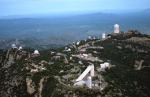 Kitt Peak National Observatory
18.01.1999
At the top of Kitt Peak Mountain near Tucson, Arizona lies one of the world's great collections of telescopes. As pictured, in the dome at the far left lies the 3.5-meter WIYN Telescope, famous recently for tracking distant supernovae.
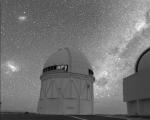 A Cerro Tololo Sky
14.05.2001
High atop a Chilean mountain lies one of the premier observatories of the southern sky: Cerro Tololo. Pictured above is one of the premier telescopes of the Cerro Tololo Inter-American Observatory (CTIO) and of the past quarter-century: the 4-meter Blanco Telescope.
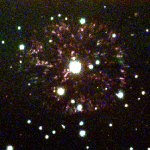 The Firework Nebula
4.07.1995
The Firework Nebula, known to astronomers as "GK Per", is the result of a type of stellar explosion called a nova. In a nova, a very compact star called a white dwarf blasts away gas that had accumulated on its surface.
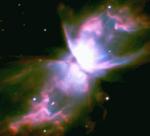 NGC 6302: The Butterfly Nebula
2.06.1998
The Butterfly Nebula is only thousands of years old. As a central star of a binary system aged, it threw off its outer envelopes of gas in a strong stellar wind. The remaining stellar core is so hot it ionizes the previously ejected gas, causing it to glow.
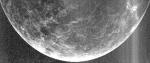 A Radar Image of Venus
15.05.2001
The largest radio telescopes in the world are working together to create a new map of the surface of Venus. The surface of Venus is unusually hidden by a thick atmosphere of mostly carbon dioxide gas. These thick clouds are transparent, however, to radar signals sent and received from Earth.
|
January February March April May June July August September October |
|||||||||||||||||||||||||||||||||||||||||||||||||