
|
You entered: telescope
 Earths Major Telescopes Investigate GRB 130427A
8.05.2013
A tremendous explosion has occurred in the nearby universe and major telescopes across Earth and space are investigating. Dubbed GRB 130427A, the gamma-ray burst was first seen by the Earth-orbiting Swift satellite in high energy X-rays and quickly reported down to Earth.
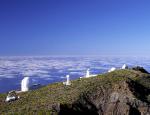 Roque de los Muchachos Observatory
19.08.2002
Above the clouds, atop an island off the coast of Africa, a group of cutting-edge telescopes inspects the universe. Pictured above are telescopes at Roque de los Muchachos Observatory on La Palma, one of the Canary Islands, Spain. The site is one of the premier observing locations on Earth.
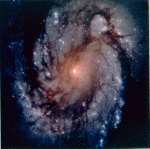 Spiral Galaxy M100
26.06.1995
The M100 galaxy is a large spiral galaxy similar to our own Milky Way, containing over 100 billion stars. It is over 150 million light years away, so the light we see left when dinosaurs roamed the Earth.
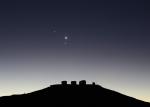 Planets over Paranal
17.08.2005
Very bright planets and very large telescopes are part of this sunset view of Paranal Observatory. The observatory's four, massive 8.2 meter telescope units are situated on top of the 2,600 meter high mountain, Cerro Paranal, in the dry Atacama Desert in northern Chile.
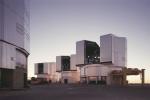 Sirius, Sun, Moon, and Southern Cross
7.07.2000
From left to right are the enclosures of Yepun (ye-poon; Sirius), Antu (an-too; Sun), Kueyen (qua-yen; Moon), and Melipal (me-li-pal; Southern Cross), pictured here as night falls at Paranal Observatory in northern Chile. These are the four 8.2 meter wide telescope units of the European Southern Observatory's Very Large Telescope (VLT).
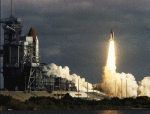 Columbia Waits, Discovery Launches
8.08.1995
Space Shuttle Discovery launches while the Space Shuttle Columbia is readied for a future mission. Space shuttles are launched from the Kennedy Space Center in Florida. At this date there are four operating space shuttles: Atlantis, Columbia, Discovery, and Endeavour. This mission is most famous for carrying the Hubble Space Telescope into orbit.
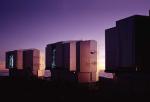 The VLT Interferometric Array
9.03.1999
The Very Large Telescope (VLT) Interferometric Array will be able to act as individual telescopes or as one huge telescope. Of the four planned VLTs in Chile, two have now reached completion. The first VLT to operate is visible on the left of the above photograph and was recently given the name Antu.
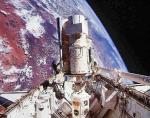 Astro 2 In Orbit
17.03.2001
Six years ago, a cluster of three ultraviolet telescopes flew into orbit on the Astro-2 mission aboard the space shuttle Endeavour. Seen here perched in Endeavour's payload bay about 350 kilometers above the Australian desert are the Hopkins Ultraviolet Telescope (HUT), the Ultraviolet Imaging Telescope (UIT), and the Wisconsin Ultraviolet Photo-Polarimeter Experiment (WUPPE).
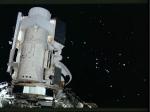 Astro 1 In Orbit
3.12.2005
Fifteen years ago, in December of 1990, the Space Shuttle Orbiter Columbia carried an array of astronomical telescopes high above the Earth's obscuring atmosphere to explore the Universe at ultraviolet and x-ray wavelengths.
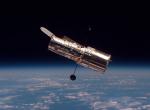 Hubble Floats Free
24.11.2002
Why put observatories in space? Most telescopes are on the ground. On the ground, you can deploy a heavier telescope and fix it more easily. The trouble is that Earth-bound telescopes must look through the Earth's atmosphere.
|
January February March April May June July August September October |
|||||||||||||||||||||||||||||||||||||||||||||||||