
|
You entered: telescope
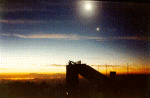 The McMath-Pierce Solar Observatory
15.03.1996
This odd-looking structure silhouetted in the foreground houses the three largest solar telescopes in the world. Located in Kitt Peak, Arizona, the largest telescope inside the McMath-Pierce Facility is 1.6-meters in diameter and contains only mirrors. The telescope contains no windows or lenses because focusing bright sunlight would overheat them.
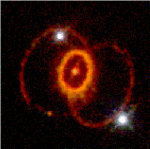 Supernova 1987a Aftermath
21.06.1995
In 1987 a star in one of the Milky Way's satellite galaxies exploded. In 1994 the Hubble Space Telescope, in orbit around the earth, took a very detailed picture of the remnants of this explosion. This picture, above, showed unusual and unexpected rings, and astronomers are not sure how they formed.
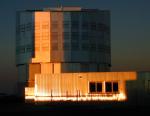 Yepun
Yepun
27.09.2000
Pictured above on September 3rd, the enclosure for the 8.2 meter telescope christened Yepun glints dramatically in the light of the setting sun. Later that evening, under dark skies at Paranal Observatory, Chile, astronomers...
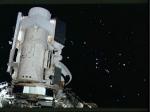 Astro 1 In Orbit
20.02.1999
In December of 1990, the Space Shuttle Columbia carried an array of astronomical telescopes high above the Earth's obscuring atmosphere to observe the Universe at ultraviolet and x-ray wavelengths. The telescopes, known...
 3 ATs
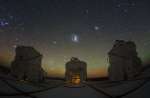
3 ATs
21.04.2012
Despite their resemblance to R2D2, these three are not the droids you're looking for. Instead, the enclosures house 1.8 meter Auxiliary Telescopes (ATs) at Paranal Observatory in the Atacama Desert region of Chile.
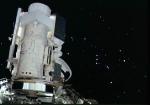 Astro 1 In Orbit
17.08.1997
In December of 1990, the Space Shuttle Columbia carried an array of astronomical telescopes high above the Earth's obscuring atmosphere to observe the Universe at ultraviolet and x-ray wavelengths. The telescopes, known...
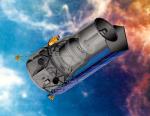 SIRTF: Name This Satellite
19.09.2001
NASA is preparing to launch its next Great Observatory in 2002, but it does not yet have a proper name. Can you help? Currently referred to only as the Space Infrared Telescope Facility (SIRTF), NASA seeks to add something more significant.
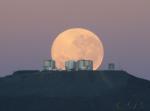 Paranal Moonset
4.11.2006
Just before the rising Sun fully illuminated the 2,635 meter summit of Cerro Paranal in northern Chile, Gordon Gillet captured this stunning moonset. In the telephoto picture, a nearly full October Moon is silhouetting the impressive array of telescopes at ESO's Paranal Observatory.
 Hubble Floats Free
25.05.2009
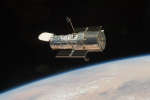
Why put observatories in space? Most telescopes are on the ground. On the ground, you can deploy a heavier telescope and fix it more easily. The trouble is that Earth-bound telescopes must look through the Earth's atmosphere.
 CFHT Star Trails
5.09.2000
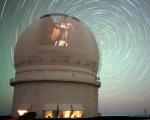
High atop a dormant volcano in Hawaii, an eye 3.6-meters wide stares at a faint light on the night sky. Unlike a human eye, which collects light for only a fraction of a second at a time, a telescope such as the Canada-France-Hawaii Telescope (CFHT) can collect light for hours.
|
January February March April May June July August September October |
|||||||||||||||||||||||||||||||||||||||||||||||||