
|
You entered: telescope
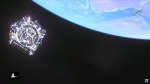 James Webb Space Telescope over Earth
26.12.2021
There's a big new telescope in space. This one, the James Webb Space Telescope (JWST), not only has a mirror over five times larger than Hubble's in area, but can see better in infrared light.
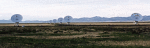 A Very Large Array of Radio Telescopes
21.06.1996
Pictured above is one of the world's premiere radio astronomical observatories: The Very Large Array (VLA). Each antenna dish is as big as a house (25 meters across) and mounted on railroad tracks. The VLA consists of 27 dishes - together capable of spanning the size of a city (35 kilometers).
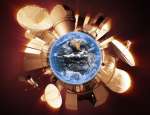 Around the World in 80 Telescopes
3.04.2009
Want to go on an extraordinary voyage? Today you can, by watching Around the World in 80 Telescopes. The 24-hour long webcast is organized by the European Southern Observatory for the International Year of Astronomy cornerstone project 100 Hours of Astronomy.
 A Very Large Array of Radio Telescopes
27.07.1997
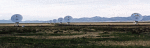
Pictured above is one of the world's premiere radio astronomical observatories: The Very Large Array (VLA). Each antenna dish is as big as a house (25 meters across) and mounted on railroad tracks. The VLA consists of 27 dishes - together capable of spanning the size of a city (35 kilometers).
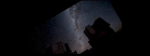 Earth Rotating Under Very Large Telescopes
1.06.2011
Why is the Earth moving in the above video? Most time lapse videos of the night sky show the stars and sky moving above a steady Earth. Here, however, the frames have been digitally rotated so that it is the stars that stay (approximately) steady, and the Earth that moves beneath them.
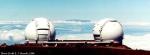 Keck: The Largest Optical Telescopes
27.12.1997
In buildings eight stories tall rest mirrors ten meters across that are slowly allowing humanity to map the universe. Alone, each is the world's largest optical telescope: Keck. Together, the twin Keck telescopes have the resolving power of a single telescope 90-meter in diameter, able to discern sources just milliarcseconds apart.
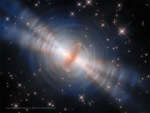 APOD: 2026 February 25 Б The Egg Nebula from the Hubble Telescope
25.02.2026
Ever wonder what it would look like to crack open the Sun? The Egg Nebula, a dying Sun-like star, can unscramble this question. Pictured is a combination of several visible and infrared images of the nebula (also known as RAFGL 2688 or CRL 2688) taken with the Hubble Space Telescope.
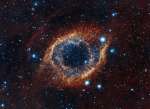 The Helix Nebula from the VISTA Telescope
31.01.2012
Will our Sun look like this one day? The Helix Nebula is one of brightest and closest examples of a planetary nebula, a gas cloud created at the end of the life of a Sun-like star.
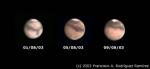 Mars Through a Small Telescope
19.08.2003
How does Mars appear through a small telescope? Viewed with the unaided eye or through a small telescope, possibly the most striking part of Mars' appearance is it's red color. The color derives from rust, iron oxide, which composes perhaps 10% of the Martian soil.
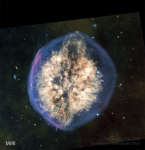 APOD: 2026 March 9 Б The Cranium Nebula from the Webb Telescope
9.03.2026
What's going on inside the head of this nebula? Dubbed the Exposed Cranium Nebula for its similarity to the human brain, what created the nebula remains a mystery. One thought is that the Cranium Nebula, also known as PMR 1, is a planetary nebula surrounding a white dwarf star.
|
January February March April May June July August September October |
|||||||||||||||||||||||||||||||||||||||||||||||||