
|
You entered: space
 A Mystery in Gamma Rays
11.08.2001
Gamma rays are the most energetic form of light, packing a million or more times the energy of visible light photons. If you could see gamma rays, the familiar skyscape of steady stars would be replaced by some of the most bizarre objects known to modern astrophysics -- and some which are unknown.
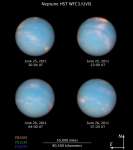 Neptune: Once Around
14.07.2011
Neptune rotates once on its axis in about 16 hours. So, spaced about 4 hours apart these 4 images of the solar system's most distant gas giant cover one Neptune day. Recorded...
 Searching For Solar Systems
15.11.1996
Observational astronomy has recently provided evidence of the existence of massive Jupiter-sized planets orbiting distant suns, protoplanetary disks of gas and dust surrounding newly formed stars, and planetary bodies orbiting exotic stellar corpses known as pulsars. Indeed, the formation of planets seems to be a broader and more varied phenomenon than previously imagined.
 APOD: 2026 July 24 Б RCW 86: Historical Supernova Remnant
24.07.2026
In 185 AD, Chinese astronomers recorded the appearance of a new star in the Nanmen asterism. That part of the sky is identified with part of the southern constellation Centaurus on modern star charts.
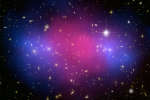 MACSJ0025: Two Giant Galaxy Clusters
Collide
MACSJ0025: Two Giant Galaxy Clusters
Collide
17.09.2008
What happens when two of the largest objects in the universe collide? No one was quite sure, but the answer is giving clues to the nature of mysterious dark matter. In the case of MACSJ0025.
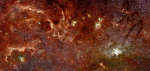 The Galactic Core in Infrared
7.01.2009
What's happening at the center of our Milky Way Galaxy? To help find out, the orbiting Hubble and Spitzer space telescopes have combined their efforts to survey the region in unprecedented detail in infrared light.
 ISS Transits Mars
23.09.2020
Yes, but have you ever seen the space station do this? If you know when and where to look, watching the bright International Space Station (ISS) drift across your night sky is a fascinating sight -- but not very unusual.
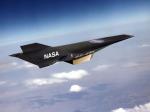 NASAs X 43A Scramjet Sets Air Speed Record
29.03.2004
Using oxygen from the air itself, a NASA experimental jet propelled itself past Mach 7 in the atmosphere above the Pacific Ocean this weekend. The small automated X-43A Hyper-X craft was dropped from a huge converted B-52 bomber and then accelerated by a standard Pegasus rocket.
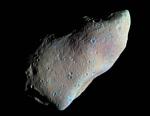 Asteroid Gaspra s Best Face
27.10.2002
Asteroid 951 Gaspra is a huge rock tumbling in space. Gaspra became one of the best-studied spacecraft Galileo flew by. In the above photograph, subtle color variations have been exaggerated to highlight changes in reflectivity, surface structure and composition.
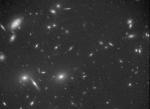 A Distant Cluster of Galaxies
7.12.1997
In this 1994 Hubble Space Telescope photograph, every bright object is a galaxy. Oddly - most of them are spiral galaxies. This rich cluster of galaxies, named CL 0939+4713, is almost half way across the visible universe.
|
January February March April May June July August September October |
|||||||||||||||||||||||||||||||||||||||||||||||||