
|
You entered: space
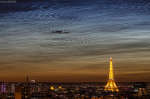 A Solstice Night in Paris
28.06.2019
The night of June 21 was the shortest night for planet Earth's northern latitudes, so at latitude 48.9 degrees north, Paris was no exception. Still, the City of Light had an exceptionally luminous evening. Its skies were flooded with silvery night shining or noctilucent clouds after the solstice sunset.
 Apollo 12 Visits Surveyor 3
24.11.1996
Apollo 12 was the second mission to land humans on the Moon. The landing site was picked to be near the location of Surveyor 3, a robot spacecraft that had landed on the moon three years earlier. Pictured above, Apollo 12 astronauts Conrad and Bean retrieve parts from the Surveyor.
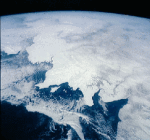 Water World
18.11.1995
Water (Dihydrogen Oxide, H2O) is a truly remarkable chemical compound and is fundamental to life on Earth. Earth is the only planet in the Solar System where the surface temperature and pressure allow the three forms of water, solid (ice), liquid (ocean), and gas (water vapor condensing in clouds) to exist simultaneously on its surface.
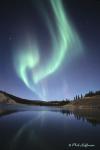 Dueling Auroras
3.12.2001
Will it be curtains for one of these auroras? A quick inspection indicates that it is curtains for both, as the designation "curtains" well categorizes the type of aurora pattern pictured. Another (informal) type is the corona. The above auroras resulted from outbursts of ionic particles from the Sun during the last week of September.
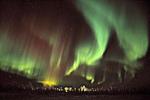 Aurora Over Circle, Alaska
1.01.1997
Aurora can make spectacular sights. This particular aurora was photographed hovering over the town of Circle, Alaska. Although Aurora might first appear to be moonlit clouds, they only add light to the sky, and hence can not block background stars from view.
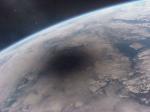 Looking Back on an Eclipsed Earth
26.09.2004
Here is what the Earth looks like during a solar eclipse. The shadow of the Moon can be seen darkening part of Earth. This shadow moved across the Earth at nearly 2000 kilometers per hour.
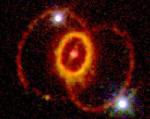 The Mysterious Rings of Supernova 1987A
31.03.2002
What's causing those odd rings in supernova 1987A? In 1987, the brightestsupernova in recent history occurred in the Large Magellanic Clouds. At the center of the picture is an object central to the remains of the violent stellar explosion.
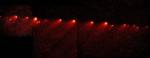 A String Of Pearls
23.03.1997
Comet Shoemaker-Levy 9, named after its co-discoverers, was often referred to as the "string of pearls" comet. It is famous for its unusual appearance as well as its collision with the planet Jupiter!
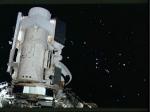 Astro 1 In Orbit
20.02.1999
In December of 1990, the Space Shuttle Columbia carried an array of astronomical telescopes high above the Earth's obscuring atmosphere to observe the Universe at ultraviolet and x-ray wavelengths. The telescopes, known...
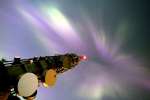 Auroral Corona Over Norway
1.02.2009
Higher than highest communications tower, higher than highest mountain, higher than highest airplane, lies the realm of the aurora. Auroras rarely reach below 60 kilometers, and can range up to 1000 kilometers. Aurora light results from energetic electrons and protons striking molecules in the Earth's atmosphere.
|
January February March April May June July August September October |
|||||||||||||||||||||||||||||||||||||||||||||||||