
|
You entered: space
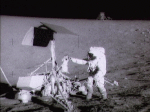 Apollo 12 Visits Surveyor 3
8.10.1995
Apollo 12 was the second mission to land humans on the Moon. The landing site was picked to be near the location of Surveyor 3, a robot spacecraft that had landed on the moon three years earlier. Pictured above, Apollo 12 astronauts Conrad and Bean retrieve parts from the Surveyor.
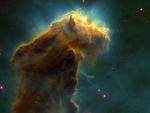 Eagle EGGs in M16
2.04.2000
Star forming regions known as "EGGs" are uncovered at the end of this giant pillar of gas and dust in the Eagle Nebula (M16). EGGs, short for evaporating gaseous globules, are dense regions of mostly molecular hydrogen gas that fragment and gravitationally collapse to form stars.
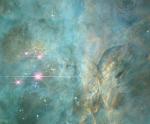 In the Center of the Trapezium
18.11.1997
Start with the constellation of Orion. Below Orion's belt is a fuzzy area known as the Great Nebula of Orion or M42. In this nebula is a bright star cluster known as the Trapezium, shown above. New stellar systems are forming there in gigantic globs of gas and dust known as Proplyds.
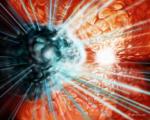 Lasers in Eta Carinae
29.11.1997
Have you heard about the great LASER light show in the sky? A team led by K. Davidson (U. Michigan) and S. Johansson (U. Lund) discovered that the chaotically variable star Eta Carinae emits ultraviolet light in such a narrow band that it is most probably LASER light!
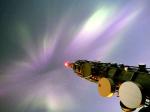 Aurora Over a Communications Tower
28.09.2004
Higher than highest communications tower, higher than highest mountain, higher than highest airplane, lies the realm of the aurora. Auroras rarely reach below 60 kilometers, and can range up to 1000 kilometers. Aurora light results from energetic electrons and protons striking molecules in the Earth's atmosphere.
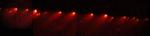 A String Of Pearls
25.05.2002
Comet Shoemaker-Levy 9, named after its co-discoverers, was often referred to as the "string of pearls" comet. It is famous for its suggestive appearance as well as its collision with the planet Jupiter!
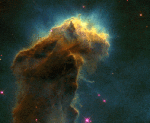 Eagle EGGs in M16
7.11.1995
Star forming regions known as "EGGs" are uncovered at the end of this giant pillar of gas and dust in the Eagle Nebula (M16). EGGs, short for evaporating gaseous globules, are dense regions of mostly molecular hydrogen gas that fragment and gravitationally collapse to form stars.
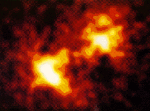 An X-ray Hot Supernova in M81
3.12.1995
In 1993, a star in the galaxy M81 exploded. Above is a picture of the hot material ejected by this supernova explosion. The picture was taken in X-rays with the Advanced Satellite for Cosmology and Astrophysics (ASCA).
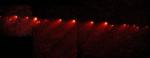 A String Of Pearls
14.08.1999
Comet Shoemaker-Levy 9, named after its co-discoverers, was often referred to as the "string of pearls" comet. It is famous for its suggestive appearance as well as its collision with the planet Jupiter!
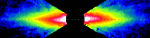 The Dusty Disk of Beta Pic
19.01.1996
This dusty disk, viewed edge on surrounding Beta Pictoris, a star only 50 lightyears distant, may signal the presence of an infant solar system. Beta Pictoris is a young Sun-like star just completing its formative stages.
|
January February March April May June July August September October |
|||||||||||||||||||||||||||||||||||||||||||||||||