
|
You entered: space
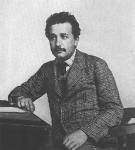 Albert Einstein: 1879 - 1955
18.12.1995
Albert Einstein is considered by many the greatest astrophysicist. He is pictured here in the Swiss Patent Office where he did much of his great work. Einstein's many visionary scientific contributions include...
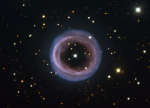 Shapley 1: An Annular Planetary Nebula
16.08.2011
What happens when a star runs out of nuclear fuel? For stars about the mass of our Sun, the center condenses into a white dwarf while the outer atmospheric layers are expelled into space and appear as a planetary nebula.
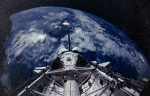 Lightning Below
1.12.1995
In May of 1993, the Space Shuttle Columbia orbited the Earth carrying the Spacelab Deutsche 2 (SL-D
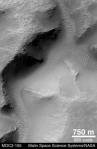 A Martian Valley
23.07.1999
This tantalizing close-up detail of a network of martian valleys was recorded from orbit this April by Mars Global Surveyor's camera. Water may once have flowed here but now sand dunes stripe the windswept valley floor.
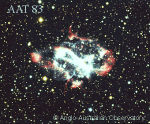 NGC 5189: A Strange Planetary Nebula
10.12.1995
After a Sun-like star can no longer support fusion in its core, the center condenses into a white dwarf while the outer atmospheric layers are expelled into space and appear as a planetary nebula. This particular planetary nebula has a quite strange and chaotic structure.
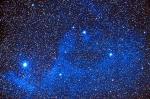 Starlight Reflections
14.04.1998
Wisps of dust fill the space between the stars. This dust is usually invisible, subtly acting to dim the light of more distant stars. Sometimes this dust is thick and prominent as dark patches on otherwise bright emission nebulae. Other times this dust may show itself by reflecting the light of bright, nearby stars.
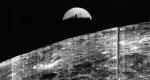 The Earth Also Rises
24.03.2000
The Lunar Orbiter 1 spacecraft was launched in 1966 to map the lunar surface in preparation for the Apollo moon landings. NASA's plucky robotic explorer performed its job well and pioneered this classic view of the Earth poised above the lunar horizon.
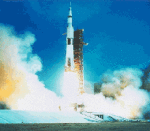 Saturn V: NASA's Largest Rocket
29.08.1995
Pictured, a NASA Saturn V rocket blasts off on July 16th, 1969 carrying the crew of Apollo 11 to the Moon. The Saturn V rocket was the largest rocket ever used by NASA, and the only one able to lift the large masses needed to land astronauts on the moon and returning them safely.
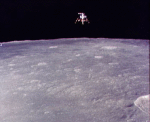 Apollo 12's Lunar Module Descends
6.10.1995
A few months after Apollo 11's historic Moon landing, Apollo 12 with commander Charles Conrad Jr., Command Module pilot Richard Gordan, and Lunar Module pilot Alan Bean returned for more geographic and scientific exploration.
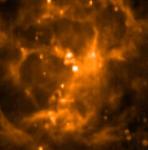 Infrared Trifid
28.08.1997
The Trifid nebula (M20) is a bright star forming region in Sagittarius, 5000 light years from Earth. In visible light, the interstellar gas cloud is crossed by dark, obscuring dust lanes which roughly divide the glowing emission nebula into three major parts.
|
January February March April May June July August September October |
|||||||||||||||||||||||||||||||||||||||||||||||||