
|
You entered: space
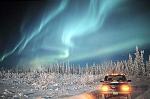 Aurora Over Alaska
4.03.1998
Higher than the highest mountain, higher than the highest airplane, lies the realm of the aurora. Aurora rarely reach below 60 kilometers, and can range up to 1000 kilometers. Aurora light results from solar electrons and protons striking molecules in the Earth's atmosphere.
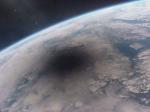 Looking Back on an Eclipsed Earth
30.08.1999
Here is what the Earth looks like during a solar eclipse. The shadow of the Moon can be seen darkening part of Earth. This shadow moves across the Earth at nearly 2000 kilometers per hour.
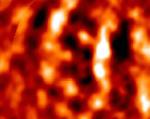 Cosmic Ripples Implicate Dark Universe
29.05.2002
What may appear fuzzy to some makes things crystal clear to others. The cosmic microwave background radiation emanating from the universe could only have the above fuzzy pattern if it contained clear amounts of dark matter and dark energy.
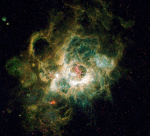 NGC 604: Giant Stellar Nursery in M33
16.08.1996
The nebula cataloged as NGC 604 is a giant star forming region, 1500 light years across, in the nearby spiral galaxy, M33. Seen here in a snapshot by the Hubble Space Telescope, over 200 newly formed, hot, massive, stars are scattered within a cavern-like, gaseous, interstellar cloud.
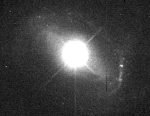 Why is QSO 1229+204 so Bright?
24.08.1996
What causes the center of this barred spiral galaxy to light up brighter than almost anything in the universe? The quasar there is a good fraction of the way across our observable universe...
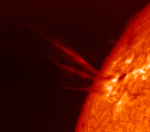 A Solar Corona Ejection
8.11.1996
The Sun would not be a nice place to spend the summer. One reason, besides the extreme heat, is that explosions are common there. In the above picture, magnetic fields buckle releasing previously constrained hot material from the upper atmosphere of the Sun.
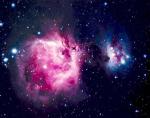 The Great Nebula in Orion
27.01.1998
The Great Nebula in Orion can be found just below and to the left of the easily identifiable belt of three stars in the popular constellation Orion. This fuzzy patch contains one of the closest stellar nurseries, lying at a distance of about 1500 light years.
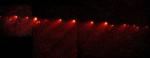 A String Of Pearls
1.08.1998
Comet Shoemaker-Levy 9, named after its co-discoverers, was often referred to as the "string of pearls" comet. It is famous for its suggestive appearance as well as its collision with the planet Jupiter!
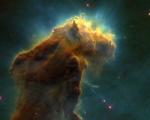 Eagle Eggs in M16
28.02.1998
Star forming regions known as "EGGs" are uncovered at the end of this giant pillar of gas and dust in the Eagle Nebula (M16). EGGs, short for evaporating gaseous globules, are dense regions of mostly molecular hydrogen gas that fragment and gravitationally collapse to form stars.
 Strawberry Sun
29.08.2013
This striking, otherworldy scene really is a view from planet Earth. The ochre sky and strawberry red sun were photographed on August 22nd near the small village of Strawberry, California, USA. Found along Highway...
|
January February March April May June July August September October |
|||||||||||||||||||||||||||||||||||||||||||||||||