
|
You entered: space
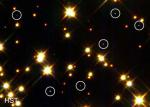 White Dwarf Stars Cool
10.09.2000
Diminutive by stellar standards, white dwarf stars are also intensely hot ... but they are cooling. No longer do their interior nuclear fires burn, so they will continue to cool until they fade away. This Hubble Space Telescope image covers a small region near the center of a globular cluster known as M4.
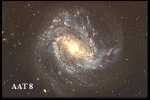 Spiral Galaxy M83
19.04.1997
The long winding arms of this nearby spiral galaxy define it as the "Southern Pinwheel." But M83 is quite a typical spiral - much like our own Milky Way Galaxy. Spiral galaxies contains many billions of stars, the youngest of which inhabit the spiral arms and glow strongly in blue light.
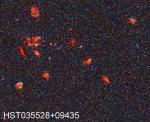 A Cluster Too Far
8.09.1998
Why is this galaxy cluster so red? Nearby clusters have galaxies with colors that are much more yellow and blue. A leading explanation is that this cluster of galaxies lies so far across our universe (z~1) that cosmological time dilation significantly reddens the light.
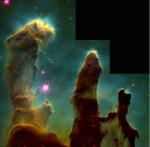 Stars from Eagles Eggs
2.05.1999
Newborn stars are forming in the Eagle Nebula. This image, taken with the Hubble Space Telescope in 1995, shows evaporating gaseous globules (EGGs) emerging from pillars of molecular hydrogen gas and dust. The giant pillars are light years in length and are so dense that interior gas contracts gravitationally to form stars.
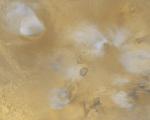 Tharsis Volcanos
18.06.1999
Ice crystal clouds float above the immense Tharsis volcanos of Mars in this recently released picture from NASA's Mars Global Surveyor spacecraft. Olympus Mons at the upper left is 340 miles across and almost 15 miles high - the largest volcano in the solar system.
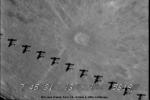 Full Moon Crossing
14.10.2006
On October 6th, a nearly full perigee Moon shone in Earth's night sky. The bright moonlight, accurate planning, and proper equipment resulted in this amazing composite featuring sharp silhouettes of the International Space Station (ISS) as it rapidly crossed (right to left) in front of the lunar disk.
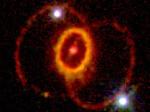 The Mysterious Rings of Supernova 1987A
7.01.2007
What's causing those odd rings in supernova 1987A? In 1987, the brightest supernova in recent history occurred in the Large Magellanic Clouds. At the center of the picture is an object central to the remains of the violent stellar explosion.
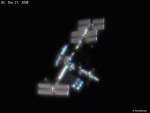 ISS: Reflections of Earth
16.01.2009
Remarkable details are visible in this view of the orbiting International Space Station (ISS), recorded with a small telescope on planet Earth through a clear twilight sky. Seen on December 27th at about...
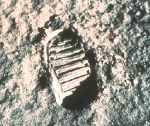 One Small Step
21.09.1995
On July 20th, 1969, a human first set foot on the Moon. Pictured above is the first lunar footprint. The footprint and distinction of the first person to walk on the Moon belong to Neil Armstrong.
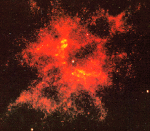 NGC 2440 Nucleus: The Hottest Star?
30.11.1995
In the center of the above photograph lies a star with one of the hottest surface temperatures yet confirmed. This bright white dwarf star's surface has been measured at greater than 200,000 degrees Celsius - more than 30 times hotter than that of our own Sun.
|
January February March April May June July August September October |
|||||||||||||||||||||||||||||||||||||||||||||||||