
|
You entered: space
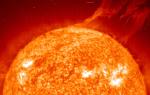 Eruptive Prominence
8.07.1999
Activity on our parent star continues to increase as the sun approaches a maximum in its 11-year solar cycle, expected in the year 2000. On June 14 - only a week before the solstice - the space-based SOHO observatory recorded this stunning view of an immense prominence erupting from the sun's southern latitudes (south is up).
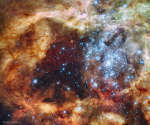 Star Cluster R136 Breaks Out
10.01.2021
In the center of nearby star-forming region lies a huge cluster containing some of the largest, hottest, and most massive stars known. These stars, known collectively as star cluster R136, part of the Tarantula Nebula, were captured in the featured image in visible light in 2009 through the Hubble Space Telescope.
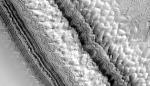 Layers of the Martian South Polar Cap
25.04.2000
The South Pole of Mars is stranger than was previously thought. Pictured above are unexpectedly complex layers photographed recently by the Mars Global Surveyor spacecraft currently orbiting Mars. The layers probably include carbon dioxide ice, water ice, rock and dust.
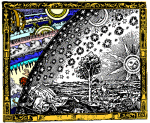 The Millennium that Defines Universe
1.01.2001
Welcome to millennium three. During millennium two, humanity continually redefined its concept of "Universe": first as spheres centered on the Earth, in mid-millennium as the Solar System, a few centuries ago as the Galaxy, and within the last century as the matter emanating from the Big Bang.
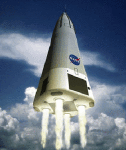 The Delta Clipper
28.10.1995
The Delta Clipper experimental rocket or DC-X is intended as a development vehicle to pave the way for a reusable single stage to orbit rocket. Shown here, in an artists conception, it has made...
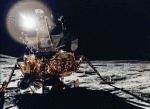 Apollo 14 on the Moon
9.12.1995
The jewel-like glare from a brilliant sun reflects off the lunar module of the Apollo 14 mission to the Moon as it rests on the lunar surface in February 1971. Astronauts Alan Shepard and Edgar Mitchell walked on the Moon's surface while astronaut Stuart Roosa piloted the orbiting command module.
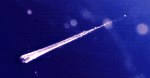 Catching Falling Stardust
25.01.1996
This carrot shaped track is actually little more than 5 hundredths of an inch long. It is the trail of a meteroid through a gel exposed to space in low earth orbit by the shuttle launched EURECA (European Recoverable Carrier) spacecraft.
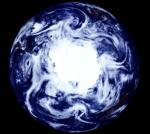 Summer at the South Pole
22.12.2002
The December solstice brings the beginning of Winter to Earth's Northern Hemisphere and Summer time to the South! This view of Earth's Southern Hemisphere near the beginning of Summer was created using images from the Galileo spacecraft taken during its December 1990 flyby of our fair planet.
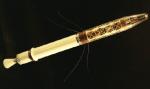 Explorer I
13.02.1998
Inaugurating the era of space exploration for the US, the First Explorer was launched into Earth orbit forty years ago (February 1, 1958) by the Army Ballistic Missle Agency. The Explorer I satellite weighed...
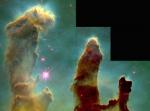 M16: Stars from Eagle's EGGs
24.04.2005
Newborn stars are forming in the Eagle Nebula. This image, taken with the Hubble Space Telescope in 1995, shows evaporating gaseous globules (EGGs) emerging from pillars of molecular hydrogen gas and dust. The giant pillars are light years in length and are so dense that interior gas contracts gravitationally to form stars.
|
January February March April May June July August September October |
|||||||||||||||||||||||||||||||||||||||||||||||||