
|
You entered: space
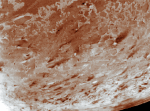 Geysers on Triton
5.08.1995
In August of 1989 NASA's Voyager 2 spacecraft passed by Neptune, the most distant of the solar system's gas giant planets. Its encounter with Neptune climaxed with its closest approach to Neptune's largest moon Triton.
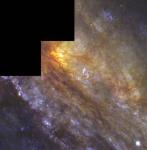 NGC 253: The Sculptor Galaxy
9.12.1998
NGC 253 is not only one of the brightest spiral galaxies visible, it is also one of the dustiest. Discovered in 1783 by Caroline Herschel in the constellation of Sculptor, NGC 253 lies only about ten million light-years distant.
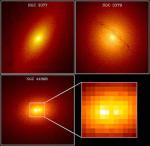 Black Holes in Galactic Centers
17.10.1999
Do all galaxies have black holes at their centers? Although not even a single galaxy has yet been proven to have a central black hole, the list of candidates continues to increase. Results...
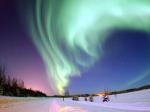 Aurora Over Alaska
9.04.2007
Higher than the highest mountain, higher than the highest airplane, lies the realm of the aurora. Aurora rarely reach below 60 kilometers, and can range up to 1000 kilometers. Aurora light results from solar shockwave causing energetic electrons and protons to striking molecules in the Earth's atmosphere.
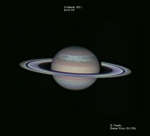 Saturn s Serpent Storm
17.03.2011
Late last year, a new, remarkably bright storm erupted in Saturn's northern hemisphere. Nicknamed "the Serpent Storm", the northern hemisphere disturbance is still going strong and now circles far around the planet. Offering...
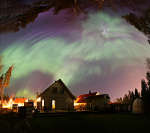 Aurora in the Backyard
18.03.2015
On the night of March 17/18 this umbrella of northern lights unfolded over backyards in Vallentuna, Sweden about 30 kilometers north of Stockholm. A result of the strongest geomagnetic storm of this solar cycle...
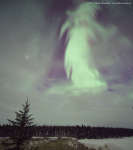 Ghost Aurora over Canada
31.10.2016
What does this aurora look like to you? While braving the cold to watch the skies above northern Canada early one morning in 2013, a most unusual aurora appeared. The aurora definitely appeared to be shaped like something , but what?
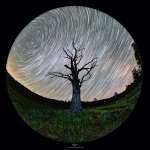 Roots on a Rotating Planet
8.07.2022
With roots on a rotating planet, an old tree is centered in this sequence of 137 exposures each 20 seconds long, recorded one night from northern Sicily. Digital camera and fisheye lens were fixed to a tripod to capture the dramatic timelapse, so the stars trailed through the region's dark sky.
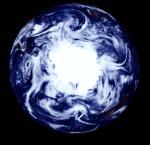 Summer at the South Pole
23.12.2000
The December solstice brings the beginning of Winter to Earth's Northern Hemisphere and Summer time to the South! This view of Earth's Southern Hemisphere near the beginning of Summer was created using images from the Galileo spacecraft taken during its December 1990 flyby of our fair planet.
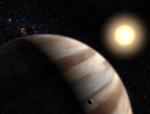 Extra Solar Planetary Atmosphere Detected
28.11.2001
By directly detecting the atmosphere of a planet outside our Solar System, humanity has taken another small step toward finding extraterrestrial life. The unexpected detection by David Charbonneau (Caltech) and associates came from Hubble Space Telescope observations of Sun-like star HD 209458.
|
January February March April May June July August September October |
|||||||||||||||||||||||||||||||||||||||||||||||||