
|
You entered: space
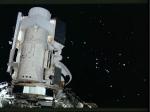 Astro 1 In Orbit
2.12.2005
Fifteen years ago, in December of 1990, the Space Shuttle Orbiter Columbia carried an array of astronomical telescopes high above the Earth's obscuring atmosphere to explore the Universe at ultraviolet and x-ray wavelengths.
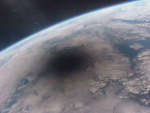 Looking Back at an Eclipsed Earth
1.01.2011
Here is what the Earth looks like during a solar eclipse. The shadow of the Moon can be seen darkening part of Earth. This shadow moved across the Earth at nearly 2000 kilometers per hour.
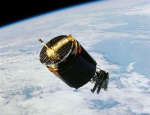 The Astronaut Who Captured a Satellite
9.12.2012
In 1984, high above the Earth's surface, an astronaut captured a satellite. It was the second satellite captured that mission. Pictured above, astronaut Dale A. Gardner flies free using the Manned Maneuvering Unit and begins to attach a control device dubbed the Stinger to the rotating Westar 6 satellite.
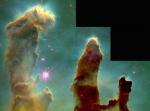 M16: Stars from Eagle's EGGs
24.11.2001
Newborn stars are forming in the Eagle Nebula. This image, taken with the Hubble Space Telescope in 1995, shows evaporating gaseous globules (EGGs) emerging from pillars of molecular hydrogen gas and dust. The giant pillars are light years in length and are so dense that interior gas contracts gravitationally to form stars.
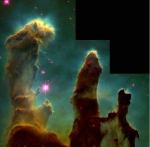 M16: Stars from Eagle's Eggs
24.09.2000
Newborn stars are forming in the Eagle Nebula. This image, taken with the Hubble Space Telescope in 1995, shows evaporating gaseous globules (EGGs) emerging from pillars of molecular hydrogen gas and dust. The giant pillars are light years in length and are so dense that
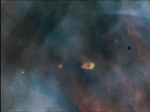 Proplyds: Infant Solar Systems
11.09.1995
The fuzzy blobs seen above may be some of the first ever images of entire solar systems forming right before our eyes. This close up of the Orion Nebulae taken by the Hubble Space...
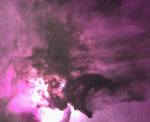 A Close-Up of the Lagoon Nebula
20.08.1996
Ribbons of red-glowing gas and dark dust surround massive young stars in this close-up of the Lagoon Nebula taken by the Hubble Space Telescope. The Lagoon Nebula is relatively close and bright - it appears larger than the Full Moon and is visible even without a telescope.
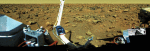 The Search for Life on Mars
21.07.1995
Although images of Mars taken from space revealed the planet to have a barren and cratered surface, scientists did not give up the search for martian life. In 1976 NASA's Viking project succeeded in landing two robot probes on the surface of Mars.
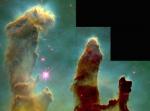 M16: Stars from Eagles EGGs
26.10.2003
Newborn stars are forming in the Eagle Nebula. This image, taken with the Hubble Space Telescope in 1995, shows evaporating gaseous globules (EGGs) emerging from pillars of molecular hydrogen gas and dust. The giant pillars are light years in length and are so dense that interior gas contracts gravitationally to form stars.
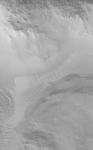 Mars in the New Year
5.01.2000
Many will long remember where they were and what they were doing when the calendar rolled over to the year 2000. On Mars, of course, that date was nothing special and the Mars Global Surveyor spacecraft continued with business as usual - systematically recording images of the Red Planet from orbit.
|
January February March April May June July August September October |
|||||||||||||||||||||||||||||||||||||||||||||||||