
|
You entered: space
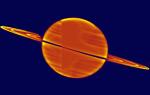 Sunlight Through Saturns Rings
24.06.2000
Normally, earth-bound astronomers view Saturn's spectacular ring system fully illuminated by reflected sunlight. However, this intriguing picture was made to take advantage of an unusual orientation, with the Sun actually illuminating the rings from below. The three bright ring features are visible because the rings themselves are not solid.
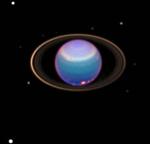 Infrared Uranus
20.10.1998
The Sun's third largest planet usually looks quite dull. Uranus typically appears as a featureless small spot in a small telescope or a featureless large orb in a large telescope. Last August, however...
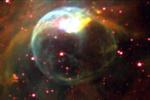 NGC 7635: The Bubble Nebula
17.11.1998
What created this huge space bubble? A massive star that is not only bright and blue, but also emitting a fast stellar wind of ionized gas. The Bubble Nebula is actually the smallest...
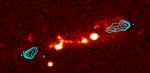 An Energetic Radio Galaxy
30.09.1995
The radio and optical emission seen in the above superposed images of the radio galaxy 3C368 indicate that energetic processes are at work. A radio galaxy is a galaxy that is visible to radio telescopes. A large radio signal usually indicates very powerful phenomena.
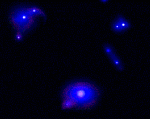 Two Billion Years After the Big Bang
7.09.1996
What did the universe look like two billion years after the Big Bang? According to this computer model, the universe was filled with irregular looking objects like the ones shown above. The simulation then predicts that these blobs of stars and gas collide to form galaxies more similar to the ones we see today.
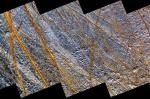 Plains and Ridges on Europa
15.12.1998
The ridges on Europa may be caused by cold water volcanoes. Europa, one of the largest moons of Jupiter, has been the source of intense scrutiny since speculation increased of there being oceans beneath its icy surface.
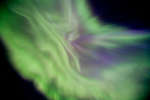 A Floral Aurora Corona
28.07.2009
Few auroras show this level of detail. Above, a standard digital camera captured a particularly active and colorful auroral corona that occurred last week above Alberta, Canada. With a shape reminiscent of a flower, the spectacular aurora had an unusually high degree of detail.
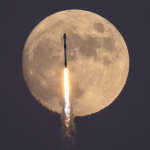 The Falcon and the Hunter s Moon
14.10.2022
The Full Moon of October 9th was the second Full Moon after the northern hemisphere autumnal equinox, traditionally called the Hunter's Moon. According to lore, the name is a fitting one because this Full Moon lights the night during a time for hunting in preparation for the coming winter months.
 Meteor Borealis
16.08.2024
A single exposure made with a camera pointed almost due north on August 12 recorded this bright Perseid meteor in the night sky west of Halifax, Nova Scotia, Canada. The meteor's incandescent trace is fleeting.
 The Long Jet of Pictor A
19.06.2000
A jet stretching nearly a million light years has been imaged emanating from galaxy Pictor A. The thin jet of electrons and protons shoots out at nearly light-speed likely from the vicinity of a large black hole at the galaxy center.
|
January February March April May June July August September October |
|||||||||||||||||||||||||||||||||||||||||||||||||