
|
You entered: space
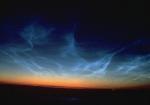 Noctilucent Clouds
19.06.2005
Sometimes it's night on the ground but day in the air. As the Earth rotates to eclipse the Sun, sunset rises up from the ground. Therefore, at sunset on the ground, sunlight still shines on clouds above.
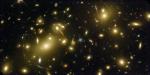 Abell 2218: A Galaxy Cluster Lens
1.02.2000
Gravity can bend light. Almost all of the bright objects in this recently released Hubble Space Telescope image are galaxies in the cluster known as Abell 2218. The cluster is so massive and so compact that its gravity bends and focuses the light from galaxies that lie behind it.
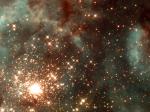 Star Cluster R136 Bursts Out
6.05.2007
In the center of star-forming region 30 Doradus lies a huge cluster of the largest, hottest, most massive stars known. These stars, known as the star cluster R136, and part of the surrounding nebula are captured here in this gorgeous visible-light image from the Hubble Space Telescope.
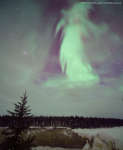 Ghost Aurora over Canada
27.10.2019
What does this aurora look like to you? While braving the cold to watch the skies above northern Canada early one morning in 2013, a most unusual aurora appeared. The aurora definitely appeared to be shaped like something , but what?
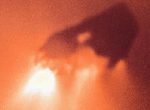 An Orbiting Iceberg
21.08.1995
A comet nucleus, formed from the primordial stuff of the solar system, resembles a very dirty iceberg. Orbiting far from our Sun, it can remain frozen, preserved for billions of years. Occasionally, a chance gravitational encounter will alter this distant orbit and send the nucleus plummeting towards the inner solar system.
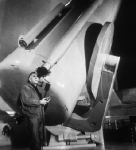 Edwin Hubble Discovers the Universe
17.02.1996
No person in history has had greater impact in determining the extent of our universe than Edwin Hubble. From proving that other galaxies existed to proving that galaxies move apart from one another, Hubble's work defined our place in the cosmos.
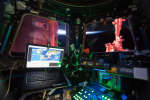 Interior View
22.01.2015
Some prefer windows, and these are the best available on board the International Space Station. Taken on January 4, this snapshot from inside the station's large, seven-window Cupola module also shows off a workstation for controlling Canadarm2.
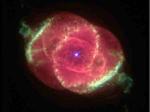 The Cats Eye Nebula
24.03.2002
Three thousand light-years away, a dying star throws off shells of glowing gas. This image from the Hubble Space Telescope reveals the Cat's Eye Nebula to be one of the most complex planetary nebulae known.
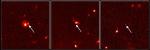 A Distant Destiny
14.01.1998
Watching galaxies recede, observational astronomers of the 20th century discovered an astounding fact - the Universe is expanding. Will it continue to expand forever? The speed of light is finite so looking into the distant Universe is equivalent to looking at the distant past.
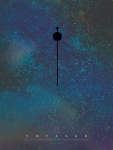 Milky Way Voyager
2.09.2017
Launched in 1977 on a tour of the outer planets of the Solar System, Voyager 1 and 2 have become the longest operating and most distant spacecraft from Earth. Nearly 16 light-hours from...
|
January February March April May June July August September October |
|||||||||||||||||||||||||||||||||||||||||||||||||