
|
You entered: space
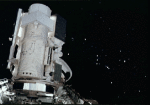 Astro 1 In Orbit
4.05.1996
In December of 1990, the Space Shuttle Columbia carried an array of astronomical telescopes high above the Earth's obscuring atmosphere to observe the Universe at ultraviolet and x-ray wavelengths. The telescopes, known...
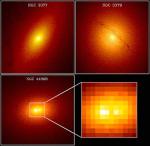 Black Holes and Galactic Centers
14.01.1997
Do all galaxies have black holes at their centers? Although not even a single galaxy has yet been proven to have a central black hole, the list of candidates has increased yet again. Recent...
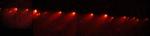 A String Of Pearls
24.07.2004
Comet Shoemaker-Levy 9, named after its co-discoverers, was often referred to as the "string of pearls" comet. It is famous for its suggestive appearance as well as its collision with the planet Jupiter!
 A Cosmic Call to Nearby Stars
12.07.2009
If Earth received this message from deep space, could we decode it? The people from the Cosmic Call project sent the above image as the first page of a longer message. The message was broadcast toward local stars by radio telescope during the summer of 1999. Another message was sent in 2003.
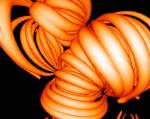 Solar Magnetic Bananas
29.06.1998
Is that our Sun? The unusual banana-shaped loops shown above are actually part of a computer-generated snap-shot of our Sun's magnetic field. This animated frame was constructed using data from the ground-based U.S. Solar Vector Magnetograph and the space-based Japanese X-Ray Telescope Yohkoh.
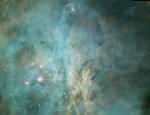 In the Center of the Trapezium
10.07.2005
Start with the constellation of Orion. Near Orion's belt is a fuzzy area known as the Great Nebula of Orion or M42. In this nebula is a bright star cluster known as the Trapezium, shown above. New stellar systems are forming there in gigantic globs of gas and dust known as Proplyds.
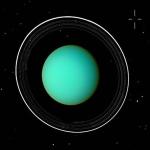 Uranus Moon 18
31.05.1999
The discovery was there for the taking. An image of Uranus taken by Voyager 2 as it passed the giant planet 13 years ago apparently recorded a moon that had since gone unnoticed. The image on which Uranus' 18th moon was discovered was freely available from NASA. Erich Karkoschka (U.
 Earth and Moon from Saturn
22.07.2013
You are here. Everyone you've ever known is here. Every human who has ever lived -- is here. Pictured above is the Earth-Moon system as captured by the Cassini mission orbiting Saturn in the outer Solar System.
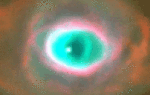 The Eye of an Hourglass Nebula
9.02.1996
What's happening in the eye-like center of this planetary nebula? The geometry revealed in this Hubble Space Telescope view of the central part of an "etched hourglass nebula" known as MyCn 18 presents a puzzle. First, the axis of this central region does not line up well with the outer hourglass structure.
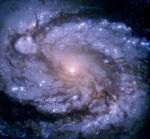 M100: A Grand Design
1.06.1997
Majestic on a truly cosmic scale, M100 is appropriately known as a Grand Design spiral galaxy. A large galaxy of over 100 billion or so stars with well defined spiral arms, it is similar to our own Milky Way.
|
January February March April May June July August September October |
|||||||||||||||||||||||||||||||||||||||||||||||||