
|
You entered: color
 NGC 1365: Majestic Island Universe
28.12.2018
Barred spiral galaxy NGC 1365 is truly a majestic island universe some 200,000 light-years across. Located a mere 60 million light-years away toward the chemical constellation Fornax, NGC 1365 is a dominant member of the well-studied Fornax galaxy cluster.
 HR 4796A: A Recipe for Planets
22.04.1998
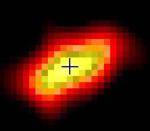
Two hundred and twenty light years from Earth, planets are forming. Recent observations of the binary star system HR 4796 have shown that one of the stars is surrounded by a dusty gaseous disk. This disk is of the right size, age, and density for dust pellets to accrete surrounding matter.
 White Rock Fingers on Mars
13.05.2002
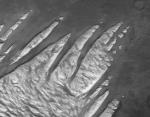
What caused this unusual white rock formation on Mars? Intrigued by the possibility that they could be salt deposits left over as an ancient lakebed dried-up, detailed studies of these fingers now indicate a more mundane origin: volcanic ash. Studying the exact color of the formation indicated the volcanic origin.
 Aurora Astern
26.10.1995
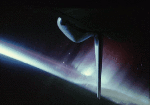
Sailing upside down, 115 nautical miles above Earth, the crew of the Space Shuttle Endeavour made this spectacular time exposure of the southern aurora (aurora australis) in October of 1994. The aurora, also known...
 Near Comet Hyakutake's Nucleus
21.03.1996
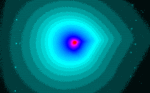
This March 19th false-color picture of Comet Hyakutake from one of the most sophisticated ground based telescopes captures the area surrounding the comet's nucleus. A comet's nucleus - not directly visible here - is a solid dirty iceball probably no more than 10 kilometers across.
 The Water Vapor Channel
12.10.1996
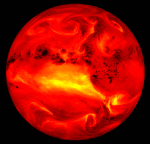
What alien planet's bizarre landscape lurks below these fiery-looking clouds? It's only Planet Earth, of course -- as seen on the Water Vapor Channel. Hourly, images like this one (shown in false color) are brought to you by the orbiting GOES 8 satellite's multi-channel imager.
 The Bubble Nebula from NOAO
17.06.2003
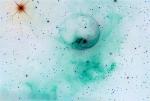
It's the bubble versus the cloud. NGC 7635, the Bubble Nebula, is being pushed out by the stellar wind of massive central star BD+602522. Next door, though, lives a giant molecular cloud, visible above to the lower right.
 M1: Filaments of the Crab Nebula
7.02.1997
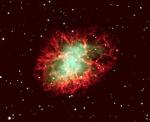
The Crab Nebula is filled with mysterious filaments. The Crab Nebula is the result of a star that exploded in 1054 AD. This spectacular supernova explosion was recorded by Chinese and (quite probably) Anasazi Indian astronomers.
 NGC 6826: The Blinking Eye
19.12.1997
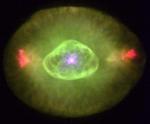
The colorful planetary nebula phase of a sun-like star's life is brief. Almost in the "blink of an eye" - cosmically speaking - the star's outer layers are cast off, forming an expanding emission nebula. This nebula lasts perhaps 10 thousand years compared to a 10 billion year stellar life span.
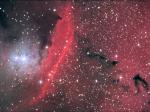 In the Center of NGC 6559
29.06.2004
Bright gas and dark dust permeate the space between stars in the center of a nebula known as NGC 6559. The gas, primarily hydrogen, is responsible for the diffuse red glow of the emission nebula.
|
January February March April May June July August September October |
|||||||||||||||||||||||||||||||||||||||||||||||||