
|
You entered: color
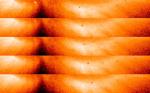 X-ray Transit of Mercury
2.07.1998
This sequence of false color X-ray images captures a rare event - the passage or transit of planet Mercury in front of the Sun. Mercury's small disk is silhouetted against the bright background of X-rays from the hot Solar Corona.
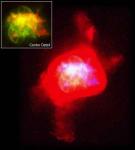 NGC 6210: The Turtle in Space Planetary Nebula
28.10.1998
A Turtle in Space? Planetary nebula NGC 6210 may look like a giant space turtle, but it is actually much more massive and violent. Fortunately, this gas cloud in Hercules lies about 6500 light years away.
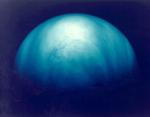 Venus: Just Passing By
25.06.2005
Venus, the second closest planet to the Sun, is by far the brightest of the three planets gathered in this weekend's western sky at sunset. It has also proven to be a popular way-point for spacecraft headed for the gas giant planets in the outer reaches of the solar system. Why visit Venus first?
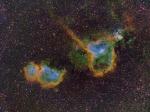 The Heart and Soul Nebulas
10.08.2005
Is the heart and soul of our Galaxy located in Cassiopeia? Possibly not, but that is where two bright emission nebulas nicknamed Heart and Soul can be found. The Heart Nebula, officially dubbed IC 1805 and visible above on the right, has a shape reminiscent of a classical heart symbol.
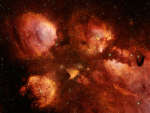 NGC 6334: The Cats Paw Nebula
4.03.2008
Nebulae are perhaps as famous for being identified with familiar shapes as perhaps cats are for getting into trouble. Still, no known cat could have created the vast Cat's Paw Nebula visible in Scorpius.
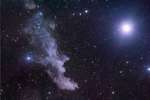 A Witch by Starlight
31.10.2008
By starlight this eerie visage shines in the dark, a crooked profile evoking its popular name, the Witch Head Nebula. In fact, this entrancing telescopic portrait gives the impression the witch has fixed her gaze on Orion's bright supergiant star Rigel.
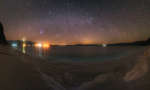 Sky Panorama Over Lake Salda
22.04.2009
As midnight approached, a spectacular sky appeared. Such was the case last month from the shore of Lake Salda in southwestern Turkey. In the above night sky panorama, rocky sand covers the foreground, while building lights are visible across the lake.
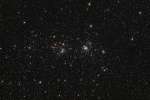 The Double Cluster
4.12.2009
A lovely starfield in the heroic northern constellation Perseus holds this famous pair of open or galactic star clusters, h and Chi Perseii. Also cataloged as NGC 869 (right) and NGC 884, both clusters are about 7,000 light-years away and contain stars much younger and hotter than the Sun.
 Panorama of the Whale Galaxy
17.05.2010
The see the full length of this blue whale, scroll right. NGC 4631 is a big beautiful spiral galaxy seen edge-on at only about 30 million light-years away. This galaxy's slightly distorted wedge shape led to its popular moniker of the Whale galaxy.
 NGC 1365: Majestic Island Universe
20.08.2010
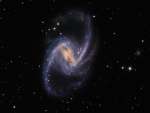
Barred spiral galaxy NGC 1365 is truly a majestic island universe some 200,000 light-years across. Located a mere 60 million light-years away toward the chemical constellation Fornax, NGC 1365 is a dominant member of the well-studied Fornax galaxy cluster.
|
January February March April May June July August September October |
|||||||||||||||||||||||||||||||||||||||||||||||||