
|
You entered: color
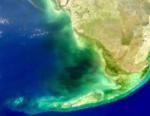 Mysterious Black Water in Florida Bay
2.04.2002
What is causing the water in Florida Bay to turn black? The mysterious black color could be seen as early as last December in images taken by the SeaWIFS instrument on board the Earth-orbiting SeaStar satellite.
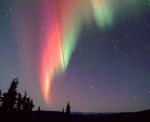 Comet and Aurora Over Alaska
22.04.2002
Can you spot the comet? Flowing across the frozen Alaskan landscape is an easily visible, colorful aurora. Just to the lower left, however, well in the background, is something harder to spot: Comet Ikeya-Zhang, the brightest comet of recent years. Although the aurora faded in minutes, the comet is just now beginning to fade.
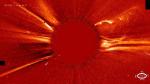 Red Sun Streaming
7.01.1997
The Sun is leaking. In fact, it is gushing: particles stream away from the Sun at hundreds of kilometers per second. Some of these particles strike the Earth and cause aurora. Most particles, however, either surround the Sun as a huge solar corona or glide into interstellar space as the solar wind.
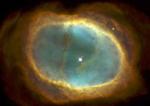 NGC 3132: The Eight Burst Nebula
10.11.1998
It's the dim star, not the bright one, near the center of NGC 3132 that created this odd but beautiful planetary nebula. Nicknamed the Eight-Burst Nebula and the Southern Ring Nebula, the glowing gas originated in the outer layers of a star like our Sun.
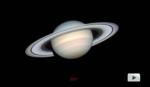 Four Years of Saturn
6.04.2007
Saturn and its magnificent ring system can offer even casual astronomers the most memorable of telescopic sights. Wandering between Leo and Cancer this month, a bright Saturn is well placed for viewing in evening skies. But from our earthbound perspective, the tilt of Saturn's rings does change with time.
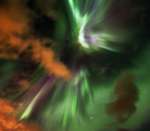 Cloudy Night of the Northern Lights
30.09.2011
On September 26, a large solar coronal mass ejection smacked into planet Earth's magnetosphere producing a severe geomagnetic storm and wide spread auroras. Captured here near local midnight from Kvaløya island outside Tromsø in northern Norway, the intense auroral glow was framed by parting rain clouds.
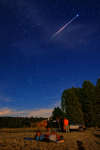 Perseid from Torralba del Burgo
13.08.2016
Perseid meteors rained on planet Earth last night. This year the stream of dust from periodic comet Swift-Tuttle has produced a stunningly active shower of bright cosmic streaks. In this 25 second long exposure...
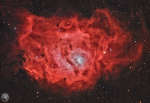 The Lagoon Nebula is Stars, Gas, and Dust
12.11.2018
The majestic Lagoon Nebula is filled with hot gas and the home for many young stars. Spanning 100 light years across while lying only about 5000 light years distant, the Lagoon Nebula is so big and bright that it can be seen without a telescope toward the constellation of the Archer (Sagittarius).
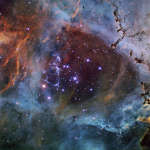 NGC 2244: A Star Cluster in the Rosette Nebula
21.02.2021
In the heart of the Rosette Nebula lies a bright open cluster of stars that lights up the nebula. The stars of NGC 2244 formed from the surrounding gas only a few million years ago.
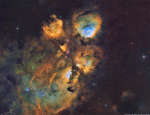 NGC 6334: The Cats Paw Nebula
10.05.2022
Nebulas are perhaps as famous for being identified with familiar shapes as perhaps cats are for getting into trouble. Still, no known cat could have created the vast Cat's Paw Nebula visible toward the constellation of the Scorpion (Scorpius.
|
January February March April May June July August September October |
|||||||||||||||||||||||||||||||||||||||||||||||||