
|
You entered: color
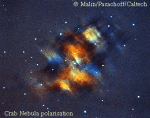 M1: Polarization of the Crab
23.11.1995
The Crab Nebula resulted from a star that exploded - a supernova. Although the stellar explosion that caused the Crab Nebula was seen over 900 years ago, the nebula itself still expands and shines. Much of the emitted light has been found to be polarized. Light waves with the same polarization vibrate in the same plane.
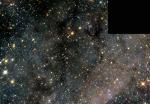 A Magellanic Starfield
4.01.2003
Stars of many types and colors are visible in this Hubble Space Telescope close-up of a starfield in the Large Magellanic Cloud (LMC). Over 10,000 stars are visible -- the brightest of which are giant stars. Were our Sun at the distance of these stars, about 170,000 light-years, it would hardly be discernable.
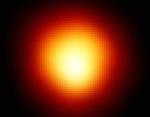 Betelgeuse
19.04.1998
Here is the first direct picture of the surface of a star other than our Sun. Taken by the Hubble Space Telescope in 1995, the atmosphere of Betelgeuse reveals some unexpected features, including a large bright hotspot visible below the center.
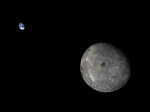 Moon and Earth from Chang e 5 T1
3.11.2014
Described at times as a big blue marble, from some vantage points Earth looks more like a small blue marble. Such was the case in this iconic image of the Earth and Moon system taken by the Chang'e 5-T1 mission last week.
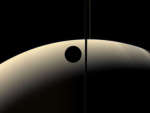 Crescent Rhea Occults Crescent Saturn
3.01.2015
Soft hues, partially lit orbs, a thin trace of the ring, and slight shadows highlight this understated view of the majestic surroundings of the giant planet Saturn. Looking nearly back toward the Sun, the robot Cassini spacecraft now orbiting Saturn captured crescent phases of Saturn and its moon Rhea in color a few years ago.
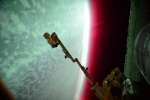 Planet Aurora
26.06.2015
What bizarre alien planet is this ? It's planet Earth of course, seen through the shimmering glow of aurorae from the International Space Station. About 400 kilometers (250 miles) above, the orbiting station is itself within the upper realm of the auroral displays, also watched from the planet's surface on June 23rd.
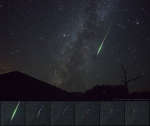 Perseid Fireball at Sunset Crater
19.08.2016
On the night of August 12, this bright Perseid meteor flashed above volcanic Sunset Crater National Monument, Arizona, USA, planet Earth. Streaking along the summer Milky Way, its initial color is likely due to the shower meteor's characteristically high speed.
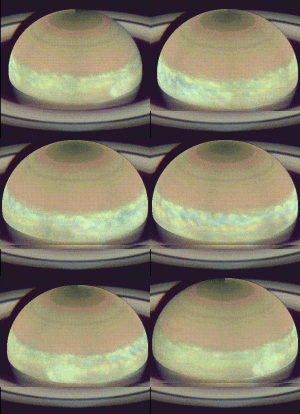 Saturn Rotates
3.10.2000
The dramatic rotation of the cloud-tops of Saturn every ten-hours is particularly evident from orbit around the gas giant planet. With a good enough telescope, however, such rotation is visible even from Earth, as shown by this time-lapse image sequence from the Hubble Space Telescope taken in November 1990.
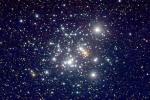 NGC 4755: A Jewel Box of Stars
18.06.2001
The great variety of star colors in this open cluster underlie its name: The Jewel Box. One of the bright central stars is a red supergiant, in contrast to the many blue stars that surround it. The cluster, also known as Kappa Crucis contains just over 100 stars, and is about 10 million years old.
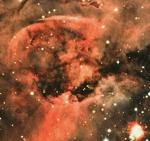 In the Center of the Keyhole Nebula
21.07.1997
Stars, like people, do not always go gentle into that good night. The above Keyhole Nebula results from dying star Eta Carinae's violently casting off dust and gas during its final centuries. Eta Carinae is many times more massive than our own Sun, and should eventually undergo a tremendous supernova explosion.
|
January February March April May June July August September October |
|||||||||||||||||||||||||||||||||||||||||||||||||