
|
You entered: color
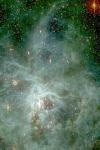 In the Heart of the Tarantula Nebula
27.10.1999
In the heart of monstrous Tarantula Nebula lies one of the most unusual star clusters. Known as NGC 2070 or R136, it is home to a great number of hot young stars. The energetic light from these stars continually ionizes nebula gas, while their energetic particle wind blows bubbles and defines intricate filaments.
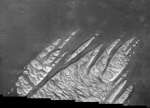 White Rock Fingers on Mars
30.10.2011
What caused this unusual light rock formation on Mars? Intrigued by the possibility that they could be lakebed dried-up, detailed studies of these fingers now indicate a more mundane possibility: volcanic ash. Studying the exact color of the formation indicated the possible volcanic origin.
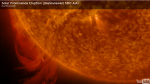 A Huge Solar Filament Erupts
31.07.2016
Filaments sometimes explode off the Sun. Featured, a huge filament had been seen hovering over the Sun's surface for over a week before it erupted late in 2010. The image sequence was taken by the Earth-orbiting Solar Dynamics Observatory (SDO) in one color of ultraviolet light.
 Alnitak, Alnilam, Mintaka
20.11.2025
Alnitak, Alnilam, and Mintaka are the bright bluish stars from east to west (upper right to lower left) along the diagonal in this cosmic vista. Otherwise known as the Belt of Orion, these three blue supergiant stars are hotter and much more massive than the Sun.
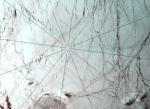 North Pole Below
20.10.2000
Orbiting over the north pole of planet Earth on May 5, the MODIS instrument on-board the Terra spacecraft, recorded this view of the ice cap 700 kilometers below. A radial grid centered on the pole is shown on top of the approximately true color image where each pixel covers about one square kilometer.
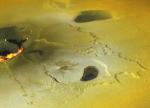 A Continuous Eruption on Jupiters Moon Io
6.06.2000
A volcano on Jupiter's moon Io has been photographed recently during an ongoing eruption. Hot glowing lava is visible on the left on this representative-color image. A glowing landscape of plateaus and valleys covered in sulfur and silicate rock surrounds the active volcano.
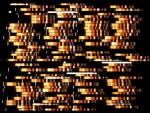 Breaking Distant Light
19.03.2002
In the distant universe, time appears to run slow. Since time-dilated light appears shifted toward the red end of the spectrum (redshifted), astronomers are able to use cosmological time-slowing to help measure vast distances in the universe.
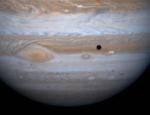 Jupiter, Io, and Shadow
7.12.2002
Pictured above is the innermost of Jupiter's Galilean satellites, Io, superposed in front of the gas giant planet. To the left of Io is a dark spot that is Io's own shadow. A solar eclipse would be seen from within the shadow spot on Jupiter.
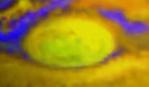 Jupiter: The Great Yellow Spot
11.03.1997
What happened to Jupiter's Great Red Spot? Operating at a chilly 55 degrees Kelvin, the Galileo Spacecraft's Near Infrared Mapping Spectrometer (NIMS) recorded this composite image of Jupiter's Great Red Spot in late June 1996.
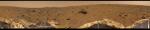 A Presidential Panorama of Mars
22.07.1997
Scroll right to unfold the latest panorama of the surface of Mars. For best viewing, click and hold on the right arrow icon at the bottom of your browser window. This image, released yesterday and dubbed a "presidential panorama" by the Mars Pathfinder team, shows in colorful detail the surroundings of the Sagan Memorial Station.
|
January February March April May June July August September October |
|||||||||||||||||||||||||||||||||||||||||||||||||