
|
You entered: color
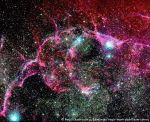 Vela Supernova Remnant in Optical
13.07.1997
About 11,000 years ago a star in the constellation of Vela exploded. This bright supernova may have been visible to the first human farmers. Today the Vela supernova remnant marks the position of a relatively close and recent explosion in our Galaxy. A roughly spherical, expanding shock wave is visible in X-rays.
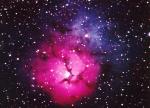 The Trifid Nebula in Red, White and Blue
8.12.1997
Three dark dust lanes give the picturesque Trifid Nebula its name. The red and blue colors of the Trifid Nebula are present in different regions and are created by different processes. A big bright star near the center of the red region appears white hot and emits light so energetic
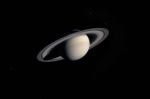 Cassini Approaches Saturn
10.12.2003
Cassini, a robot spacecraft launched in 1997 by NASA, is close enough now to resolve many rings and moons of its destination planet: Saturn. The spacecraft has now closed to within a single Earth-Sun separation from the ringed giant. Early last month, Cassini snapped the contrast-enhanced color composite pictured above.
 A Mars Panorama from the Spirit Rover
14.01.2004
If you could stand on Mars -- what would you see? Scrolling right will reveal a full color 360-degree panoramic view from NASA's Spirit Rover that landed on Mars just 10 days ago. The image is a digital mosaic from the panoramic camera that shows the view in every direction.
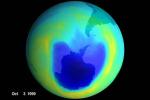 Ozone Hole Reduced
13.10.1999
Although a new ozone hole has formed again this year over the South Pole, this time it is a little bit smaller than the year before. Ozone is important because it shields us from damaging ultraviolet sunlight. Ozone is vulnerable, though, to CFCs and halons being released into the atmosphere.
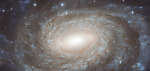 NGC 6384: Spiral Beyond the Stars
22.03.2011
The universe is filled with galaxies. But to see them astronomers must look out beyond the stars of our galaxy, the Milky Way. For example, consider this colorful telescopic view of spiral galaxy NGC 6384, about 80 million light-years away in the direction of the constellation Ophiuchus.
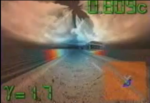 Movie: Approaching Light Speed
18.10.2011
What would it look like to travel near the speed of light? Strange visual effects would appear as documented in the above relativistically-accurate animation. First of all, relativistic aberration would cause objects to appear to bunch up in front you.
 Creature Aurora Over Norway
6.11.2013
It was Halloween and the sky looked like a creature. Exactly which creature, the astrophotographer was unsure (but possibly you can suggest one). Exactly what caused the eerie apparition was sure: one of the best auroral displays in recent memory. This spectacular aurora had an unusually high degree of detail.
 M51: The Whirlpool Galaxy from Hubble
13.06.2022
The Whirlpool Galaxy is a classic spiral galaxy. At only 30 million light years distant and fully 60 thousand light years across, M51, also known as NGC 5194, is one of the brightest and most picturesque galaxies on the sky.
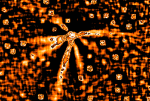 Seven Jets from Comet Hale-Bopp
13.11.1996
Comet Hale-Bopp is turning out to be quite unusual. One reason is the great amount of jet activity at such a large distance from the Sun. In the above false-color image, no less than seven jets can be seen emanating from Hale-Bopp's coma.
|
January February March April May June July August September October |
|||||||||||||||||||||||||||||||||||||||||||||||||