
|
You entered: color
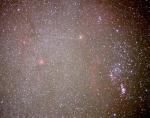 Meteor Milky Way
26.11.1998
The bold, bright star patterns of Orion (right) are a familiar sight to even casual skygazers. But this gorgeous color photo also features a subtler spectacle - the faint stars of the Milky Way.
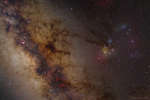 A Wide Field Image of the Galactic Center
6.01.2012
From Sagittarius to Scorpius, the central Milky Way is a truly beautiful part of planet Earth's night sky. The gorgeous region is captured in this wide field image spanning about 30 degrees.
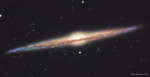 NGC 4565: Galaxy on Edge
26.05.2022
Magnificent spiral galaxy NGC 4565 is viewed edge-on from planet Earth. Also known as the Needle Galaxy for its narrow profile, bright NGC 4565 is a stop on many telescopic tours of the northern sky, in the faint but well-groomed constellation Coma Berenices.
 APOD: 2023 November 5 Б Creature Aurora Over Norway
5.11.2023
It was Halloween and the sky looked like a creature. Exactly which creature, the astrophotographer was unsure (but possibly you can suggest one). Exactly what caused this eerie apparition in 2013 was sure: one of the best auroral displays that year. This spectacular aurora had an unusually high degree of detail.
 NGC 4565: Galaxy on Edge
6.06.2024
Magnificent spiral galaxy NGC 4565 is viewed edge-on from planet Earth. Also known as the Needle Galaxy for its narrow profile, bright NGC 4565 is a stop on many telescopic tours of the northern sky, in the faint but well-groomed constellation Coma Berenices.
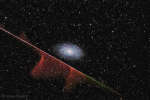 APOD: 2024 July 14 Б Meteor Misses Galaxy
14.07.2024
The galaxy was never in danger. For one thing, the Triangulum galaxy (M33), pictured, is much bigger than the tiny grain of rock at the head of the meteor. For another, the galaxy is much farther away -- in this instance 3 million light years as opposed to only about 0.0003 light seconds.
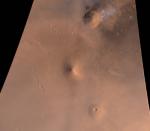 Volcanos on Mars: Elysium Region
30.07.1998
This "synthetic color" image swath of the Elysium Volcanic Region of Mars was recorded by Mars Global Surveyor's wide angle camera on July 2. North is up and the sun illuminates the scene from the lower right. Bright clouds hover near the northern most dome-shaped volcano Hecates Tholus.
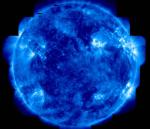 Autumn and the Active Sun
23.09.1998
As the Sun heads South, crossing the celestial equator today at 1:37 a.m. Eastern Time, Autumn begins for Earth's Northern Hemisphere. This Autumnal Equinox finds an increasingly active Sun steadily approaching a solar cycle maximum expected around the year 2003.
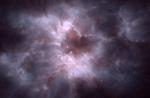 NGC 2440: Cocoon of a New White Dwarf
3.07.1999
Like a butterfly, a white dwarf star begins its life by casting off a cocoon that enclosed its former self. In this analogy, however, the Sun would be a caterpillar and the ejected shell of gas would become the prettiest of all!
 Aurora Astern
10.02.2001
Sailing upside down, 115 nautical miles above Earth, the crew of the Space Shuttle Endeavour made this spectacular time exposure of the southern aurora (aurora australis) in October of 1994. Aurora, also known as the northern and southern lights, appear as luminous bands or streamers of light which can extend to altitudes of 200 miles.
|
January February March April May June July August September October |
|||||||||||||||||||||||||||||||||||||||||||||||||