
|
You entered: color
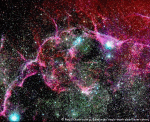 Vela Supernova Remnant in Optical
13.06.1996
About 11,000 years ago a star in the constellation of Vela exploded. This bright supernova may have been visible to the first human farmers. Today the Vela supernova remnant marks the position of a relatively close and recent explosion in our Galaxy. A roughly spherical, expanding shock wave is visible in X-rays.
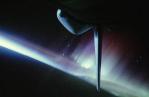 Aurora Astern
30.11.1996
Sailing upside down, 115 nautical miles above Earth, the crew of the Space Shuttle Endeavour made this spectacular time exposure of the southern aurora (aurora australis) in October of 1994. The aurora, also known...
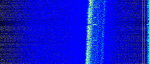 An Anomalous SETI Signal
30.03.1999
No one knows for sure what caused this signal. The bright colors on the blue background indicate that an anomalous signal was received here on Earth by a radio telescope involved in a Search for Extraterrestrial Intelligence (SETI). A search for these signals is ongoing by several groups including volunteer members of the SETI League.
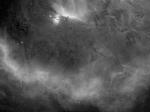 Barnards Loop around the Horsehead Nebula
17.04.2006
Why is the Horsehead Nebula surrounded by a bubble? Although glowing like an emission nebula, the origin of the bubble, known as Barnard's Loop, is currently unknown. Progenitor hypotheses include the winds from bright Orion stars and the supernovas of stars long gone.
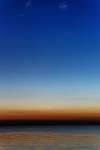 Dawn s Grande Finale
4.06.2011
After more than a month, the lovely lineup of four naked-eye planets in dawn skies is coming to a close. Still, on May 31st a slender Moon joined the grouping along the eastern horizon for a final celestial performance, presented in this early morning scene from a beach near Buenos Aires, Argentina.
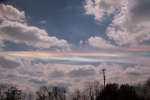 A Circumhorizontal Arc Over Ohio
24.05.2014
Why would clouds appear to be different colors? The reason here is that ice crystals in distant cirrus clouds are acting like little floating prisms. Sometimes known as a fire rainbow for its flame-like appearance, a circumhorizon arc lies parallel to the horizon.
 Bow Tie Moon and Star Trails
8.02.2018
On January 31, a leisurely lunar eclipse was enjoyed from all over the night side of planet Earth, the first of three consecutive total eclipses of the Moon. This dramatic time-lapse image followed the celestial performance for over three hours in a combined series of exposures from Hebei Province in Northern China.
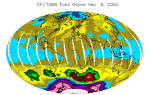 Antarctic Ozone Hole Widens
11.09.2000
It's back, and it's bigger than ever. The ozone hole that has been a cause of concern in recent years has again reformed over Earth's South Pole. The seasonal recurrence of the ozone hole was expected, although the size of the hole has never been so large this early in the season.
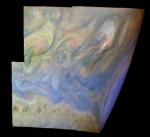 West Of The Great Red Spot
26.12.1997
The turbulent region West of Jupiter's Great Red Spot is highlighted in this recent picture constructed from data recorded by the Galileo spacecraft. The image is color coded to show cloud height and thickness; white clouds are high and thick, light blue clouds are high and thin, and reddish clouds are low.
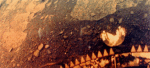 A Venus Landing
24.01.1999
This image is part of the first color panoramic view from Venus. It was transmitted by a TV camera on the Soviet Venera 13 lander which parachuted to thesurface on March 1, 1982. Venus...
|
January February March April May June July August September October |
|||||||||||||||||||||||||||||||||||||||||||||||||