
|
You entered: color
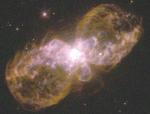 The Hubble 5 Planetary Nebula
18.01.1998
The Hubble Double Bubble Planetary Nebula is bubbling over with excitement. More mundanely known as Hubble 5, this bipolar planetary nebula is being created by a hot wind of particles streaming away from the central star system.
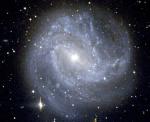 M83: A Barred Spiral Galaxy
25.05.1998
M83 is a bright spiral galaxy that can be found with a small telescope in the constellation of Hydra. M83 is a member of the Centaurus group of galaxies, a nearby group dominated by the massive galaxy Centaurus A. It takes light about 15 million years to reach us from M83.
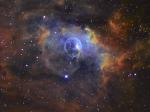 NGC 7635: The Bubble Nebula
6.11.2005
It's the bubble versus the cloud. NGC 7635, the Bubble Nebula, is being pushed out by the stellar wind of massive central star BD+602522. Next door, though, lives a giant molecular cloud, visible above to the lower right.
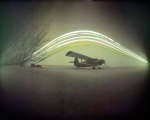 45 Days in the Sun
20.02.2015
From January 11 to February 25 2013, a pinhole camera sat in a field near Budapest, Hungary, planet Earth to create this intriguing solargraph. And for 45 days, an old Antonov An-2 biplane stood still while the Sun rose and set.
 Planet Aurora
12.05.2017
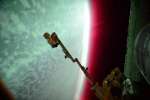
What bizarre alien planet is this? It's planet Earth of course, seen from the International Space Station through the shimmering glow of aurorae. About 400 kilometers (250 miles) above Earth, the orbiting station is itself within the upper realm of the auroral displays.
 Meteor Misses Galaxy
29.04.2019
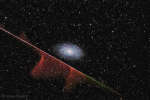
The galaxy was never in danger. For one thing, the Triangulum galaxy (M33), pictured, is much bigger than the tiny grain of rock at the head of the meteor. For another, the galaxy is much farther away -- in this instance 3 million light years as opposed to only about 0.0003 light seconds.
 M78 Wide Field
20.01.2021
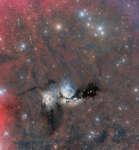
Interstellar dust clouds and glowing nebulae abound in the fertile constellation of Orion. One of the brightest, M78, is centered in this colorful, wide field view, covering an area north of Orion's belt. At a distance of about 1,500 light-years, the bluish reflection nebula is around 5 light-years across.
 The Vela Supernova Remnant Expands
3.08.1999
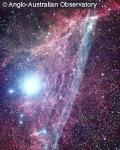
The explosion is over but the consequences continue. About eleven thousand years ago a star in the constellation of Vela exploded, creating a strange point of light briefly visible to humans living near the beginning of recorded history.
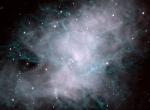 The Crab Nebula in Blue and White
11.07.2000
The Crab Nebula is a complex shell of expanding gas. The Crab Nebula formed from a star that was seen to explode in a supernova about 1000 years ago. This two color composite image taken with the WIYN 3.5-meter telescope shows in great detail filamentary structure of the glowing hydrogen gas.
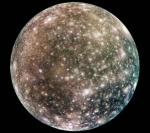 Callisto Full Face
19.01.2002
Callisto's surface shows its age. While probably formed at the same time as Io, the difference between the surfaces of these two moons of Jupiter could hardly be greater. Io's surface is young, shows practically no impact craters, and is continually being repaved by the lava exploding from its many large volcanoes
|
January February March April May June July August September October |
|||||||||||||||||||||||||||||||||||||||||||||||||