
|
You entered: color
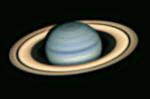 Saturn from Earth
2.09.1998
Saturn is the second largest planet in our Solar System. Saturn has been easily visible in the sky since history has been recorded. Galileo used one of the first telescopes in 1610 to discover Saturn's rings, which he first thought were moons.
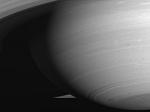 The Swirling Storms of Saturn
10.10.2005
Storms larger than hurricanes continually dot the upper atmosphere of the planet Saturn. A view of many storms occurring simultaneously was captured in July by the robot Cassini spacecraft now orbiting Saturn. An image of unusually high detail was made possible at that time when Cassini isolated a very specific color of polarized infrared light.
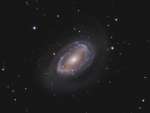 One Armed Spiral Galaxy NGC 4725
6.06.2009
While most spiral galaxies, including our own Milky Way, have two or more spiral arms, NGC 4725 seems to have only one. In this sharp color image, the solo spira mirabilis is tightly wound, traced by bluish, newborn star clusters.
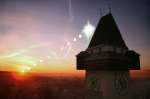 Sunrise, Moonrise
6.01.2011
For many Europeans, the Sun and New Moon rose together on January 4 in a partial solar eclipse. Arriving close on the heels of the new year, it was the first of a series of four(!) partial solar eclipses due in 2011.
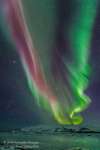 Orion and Aurora over Iceland
24.03.2014
If you see a sky like this -- photograph it. A month ago in Iceland, an adventurous photographer (pictured) chanced across a sky full of aurora and did just that. In the foreground lies the stratovolcano жrФfajЖkull. In the background, among other sky delights, lies the constellation of Orion, visible to the aurora's left.
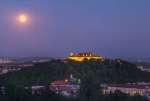 Full Moon over Brno
16.09.2016
After sunset this gorgeous full moon rose over Brno city in the Czech Republic on July 20, 2016. The panoramic image was made during a celebration of the 47th anniversary of the Apollo 11 lunar landing.
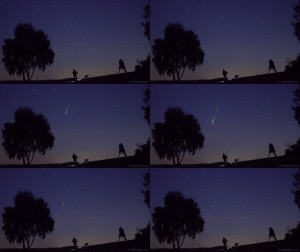 Real Time Perseid
8.09.2018
Bright meteors and dark night skies made this year's Perseid meteor shower a great time for a weekend campout. And while packing away their equipment, skygazers at a campsite in the mountains...
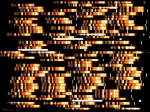 Breaking Distant Light
20.09.2020
In the distant universe, time appears to run slowly. Since time-dilated light appears shifted toward the red end of the spectrum (redshifted), astronomers are able to use cosmological time-slowing to help measure vast distances in the universe.
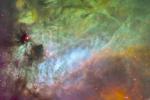 Elements of the Swan Nebula
11.08.2003
In the depths of the dark clouds of dust and molecular gas known as M17, stars continue to form. Also known as the Omega Nebula and Horseshoe Nebula, the darkness of M17's molecular clouds results from background starlight being absorbed by thick filaments of carbon-based smoke-sized dust.
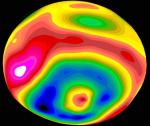 A Map of Asteroid Vesta
8.09.1997
Vesta is a huge rock 500 kilometers across that orbits out past Mars. Last week, the above map of Vesta created using the Hubble Space Telescope was released showing a rugged surface highlighted by a single crater spanning nearly the entire length of the asteroid.
|
January February March April May June July August September October |
|||||||||||||||||||||||||||||||||||||||||||||||||