
|
You entered: color
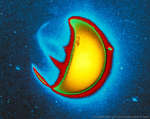 Ultraviolet Earth from an Observatory on the Moon
28.10.2018
Which planet is this? Earth. The featured false color picture shows how the Earth shines in ultraviolet (UV) light. The image is historic because it was taken from the surface of the Moon by humanity's only lunar observatory.
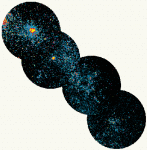 The UV SMC from UIT
20.12.1996
Translated from the "acronese" the title reads - The UltraViolet Small Magellanic Cloud from the Ultraviolet Imaging Telescope. FYI, the four ultraviolet images used in this mosaic of the nearby irregular galaxy known...
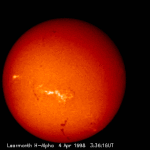 The Sun Changes
13.04.1998
Our Sun changes every day. This recent picture was taken in a very specific red color called Hydrogen-Alpha. Dark spots that might appear on the image are usually sunspots, dark magnetic depressions that are slightly cooler than the rest of the Sun's surface.
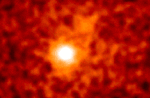 Gamma Ray Quasar
26.12.1998
The bright object in the center of the false color image above is quasar 3C279 viewed in gamma-rays, photons with more than 40 million times the energy of visible light. Like all quasars, 3C279 is a nondescript, faint, star-like object in the visible sky.
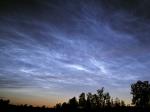 Noctilucent Clouds Over Sweden
18.07.2006
Sometimes it's night on the ground but day in the air. As the Earth rotates to eclipse the Sun, sunset rises up from the ground. Therefore, at sunset on the ground, sunlight still shines on clouds above.
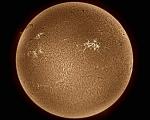 Brown Sun Bubbling
10.01.2000
Our Sun may look like all soft and fluffy, but its not. Our Sun is an extremely large ball of bubbling hot gas, mostly hydrogen gas. The above picture was taken in a specific color of light emitted by hydrogen gas called Hydrogen-alpha.
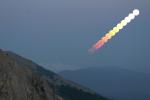 Great Mountain Moonrise
7.06.2007
On May 31st, a gorgeous Full Moon rose over Uludag Mountain in Bursa Province, Turkey. This alluring telephoto view of the twilight scene is a composite of images taken roughly every two minutes beginning shortly after Sunset, following the rising Moon as it moves up and to the right.
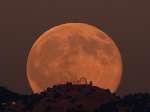 Lick Observatory Moonrise
12.12.2008
As viewed from a well chosen location at sunset, October's gorgeous Full Moon rose behind Mount Hamilton, east of San Jose, California. Captured in this lovely telescopic view, historic Lick Observatory is perched on the mountain's 4,200 foot summit, observatory and rising Moon momentarily sharing the warm color of filtered sunlight.
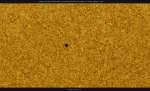 Mercury in Silhouette
13.11.2019
The small, dark, round spot in this solar close up is planet Mercury. In the high resolution telescopic image, a colorized stack of 61 sharp video frames, a turbulent array of photospheric convection cells tile the bright solar surface. Mercury's more regular silhouette still stands out though.
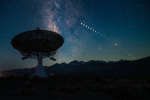 Mid Eclipse and Milky Way
27.05.2021
May's perigee Full Moon slid through Earth's shadow yesterday entertaining night skygazers in regions around the Pacific. Seen from western North America, it sinks toward the rugged Sierra Nevada mountain range in this time-lapse series of the total lunar eclipse.
|
January February March April May June July August September October |
|||||||||||||||||||||||||||||||||||||||||||||||||