
|
You entered: dark
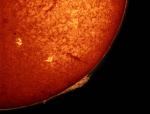 Orange Sun Simmering
29.07.2003
Even a quiet Sun is a busy place. The above image, taken in a single color of light called Hydrogen Alpha, records a great amount of detail of the simmering surface of our parent star.
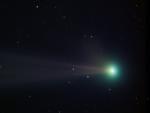 Colors of Comet Pojmanski
11.03.2006
Comet Pojmanski flew by planet Earth last weekend on a surprise trip through the inner solar system. Then an easy binocular target for morning skygazers, Pojmanski ultimately showed off a long tail, but it also presented some lovely green-blue hues as gas molecules in its tenuous coma and tail fluoresced in the sunlight.
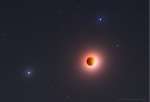 Eclipsed Moonlight
22.02.2008
Moon watchers blessed with clear skies over the Americas, Europe, Africa and western Asia enjoyed a total lunar eclipse this week. Catching eclipsed moonlight, astroimager Jerry Lodriguss offers this view of the inspiring celestial...
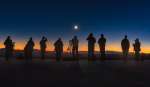 In the Shadow of the Moon
4.07.2019
On July 2 denizens of planet Earth could stand in the Moon's dark umbral shadow during South America's 2019 total solar eclipse. It first touched down in the Southern Pacific Ocean, east of New Zealand.
 APOD: 2025 January 22 Б The North America Nebula
22.01.2025
The North America nebula on the sky can do what the North America continent on Earth cannot -- form stars. Specifically, in analogy to the Earth-confined continent, the bright part that appears as the east coast is actually a hot bed of gas, dust, and newly formed stars known as the Cygnus Wall.
 APOD: 2025 September 28 Б Leopard Spots on Martian Rocks
28.09.2025
What is creating these unusual spots? Light-colored spots on Martian rocks, each surrounded by a dark border, were discovered last year by NASA's Perseverance Rover currently exploring Mars. Dubbed leopard spots because...
 Cassini Spacecraft Approaches Jupiter
11.10.2000
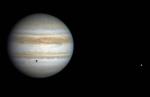
A new spacecraft has entered the outer Solar System: Cassini. Launched in 1997 and bound for Saturn in 2004, Cassini sent back the above image last week while approaching the giant planet Jupiter. Cassini joins the Galileo spacecraft currently in orbit around Jupiter in studying the gas giant and its moons.
 The Elephant s Trunk in IC 1396
20.07.2001
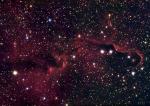
Like a picture from a galactic Just So Story, the Elephant's Trunk Nebula winds through the emission nebula and young star cluster complex IC 1396, in the high and far off constellation of Cepheus. Bright swept-back ridges compose the suggestive form, outlining pockets of interstellar dust and gas.
 Geysers on Triton
5.08.1995
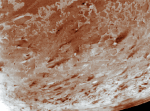
In August of 1989 NASA's Voyager 2 spacecraft passed by Neptune, the most distant of the solar system's gas giant planets. Its encounter with Neptune climaxed with its closest approach to Neptune's largest moon Triton.
 If You Could Stand on Mars
7.02.1996
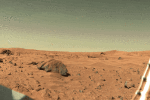
If you could stand on Mars - what would you see? Viking 1 robot landers answered this question in 1976 with pictures like the one shown above. The dark rocks, red soil, and green-tinged sky grace this rendition of a normal Martian afternoon. At the bottom corners of the picture are portions of Viking spacecraft.
|
January February March April May June July August September |
|||||||||||||||||||||||||||||||||||||||||||||||||