
|
You entered: dark
 The Deep Lagoon
27.09.2023
Ridges of glowing interstellar gas and dark dust clouds inhabit the turbulent, cosmic depths of the Lagoon Nebula. Also known as M8, The bright star forming region is about 5,000 light-years distant. It makes for a popular stop on telescopic tours of the constellation Sagittarius toward the center of our Milky Way Galaxy.
 ELT and the Milky Way
15.03.2024
The southern winter Milky Way sprawls across this night skyscape. Looking due south, the webcam view was recorded near local midnight on March 11 in dry, dark skies over the central Chilean Atacama desert.
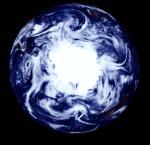 Summer at the South Pole
22.12.2000
The December solstice brings the beginning of Winter to Earth's Northern Hemisphere and Summer time to the South! This view of Earth's Southern Hemisphere near the beginning of Summer was created using images from the Galileo spacecraft taken during its December 1990 flyby of our fair planet.
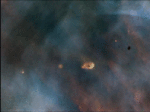 Proplyds: Infant Solar Systems?
17.10.1996
Are planets common in our galaxy? Strong evidence that the answer is "yes" was provided in this 1994 image made by the Hubble Space Telescope . A close-up of the Orion Nebulae, it reveals what seem to be disks of dust and gas surrounding newly formed stars.
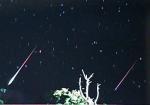 Bright Leonids
18.11.1998
Rich in bright and awesome fireballs, the Leonid Meteor Shower came early this year. In fact, judging from meteor watcher reports the peak came nearly 15 hours earlier than the best predictions. Observers...
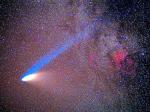 Comet Hale Bopp and the North America Nebula
3.10.2004
Comet Hale-Bopp's 1997 encounter with the inner Solar System allowed many breath-taking pictures. Above, Comet Hale-Bopp was photographed crossing the constellation of Cygnus, sporting spectacular yellow dust and blue ion tails. Visible on the right in red is the North America Nebula, a bright emission nebula observable from a dark location with binoculars.
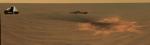 Heat Shield Impact Crater on Mars
8.02.2005
Broken metal and scorched Mars make the impact site of Opportunity's heat shield one of the more interesting sites inspected by the rolling robot. Visible on the image left is the conical outer hull of the shattered heat shield expelled by Opportunity as it plummeted toward Mars last year.
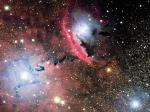 Stars, Dust and Nebula in NGC 6559
9.05.2005
When stars form, pandemonium reigns. A textbook case is the star forming region NGC 6559. Visible above are red glowing emission nebulas of hydrogen, blue reflection nebulas of dust, dark absorption nebulas of dust, and the stars that formed from them.
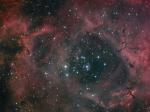 Dust and Light in the Rosette Nebula
13.02.2006
What creates the cosmic dust sculptures in the Rosette Nebula? Noted for the common beauty of its overall shape, parts of the Rosette Nebula, also known as NGC 2244, show beauty even when viewed up close.
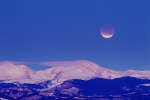 Eclipsed Moon in the Morning
24.12.2011
December's lunar eclipse graced early morning skies over the Rocky Mountains in Colorado, USA. There, this wintry scene finds the Moon in a cold blue twilight sky near the western horizon, above the snowy North American Continental Divide.
|
January February March April May June July August September |
|||||||||||||||||||||||||||||||||||||||||||||||||