
|
You entered: dark
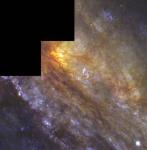 NGC 253: The Sculptor Galaxy
9.12.1998
NGC 253 is not only one of the brightest spiral galaxies visible, it is also one of the dustiest. Discovered in 1783 by Caroline Herschel in the constellation of Sculptor, NGC 253 lies only about ten million light-years distant.
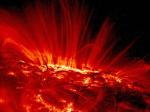 Sunspot Loops in Ultraviolet
10.10.2004
It was a quiet day on the Sun. The above image shows, however, that even during off days the Sun's surface is a busy place. Shown in ultraviolet light, the relatively cool dark regions have temperatures of thousands of degrees Celsius.
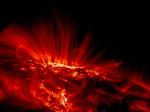 Sunspot Loops in Ultraviolet
11.06.2006
It was a quiet day on the Sun. The above image shows, however, that even during off days the Sun's surface is a busy place. Shown in ultraviolet light, the relatively cool dark regions have temperatures of thousands of degrees Celsius.
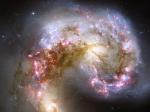 The Antennae Galaxies in Collision
24.10.2006
Two galaxies are squaring off in Corvus and here are the latest pictures. When two galaxies collide, however, the stars that compose them usually do not. This is because galaxies are mostly empty space and, however bright, stars only take up only a small amount of that space.
 Earth at Night
5.10.2008
This is what the Earth looks like at night. Can you find your favorite country or city? Surprisingly, city lights make this task quite possible. Human-made lights highlight particularly developed or populated areas of the Earth's surface, including the seaboards of Europe, the eastern United States, and Japan.
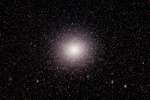 Millions of Stars in Omega Centauri
31.03.2010
Featured in the sharp telescopic image, globular star cluster Omega Centauri (NGC 5139) is some 15,000 light-years away and 150 light-years in diameter. Packed with about 10 million stars much older than...
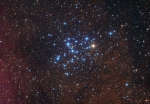 M6: The Butterfly Cluster
6.09.2011
To some, the outline of the open cluster of stars M6 resembles a butterfly. M6, also known as NGC 6405, spans about 20 light-years and lies about 2,000 light years distant.
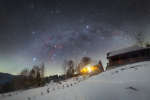 The Northern Winter Hexagon
26.12.2019
December's New Moon brought a solar eclipse to some for the holiday season. It also gave beautiful dark night skies to skygazers around the globe, like this moonless northern winter night. In the scene, bright stars of the Winter Hexagon along the Milky Way are rising.
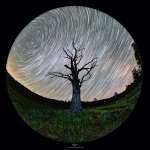 Roots on a Rotating Planet
8.07.2022
With roots on a rotating planet, an old tree is centered in this sequence of 137 exposures each 20 seconds long, recorded one night from northern Sicily. Digital camera and fisheye lens were fixed to a tripod to capture the dramatic timelapse, so the stars trailed through the region's dark sky.
 APOD: 2023 July 10 Б Stars, Dust and Nebula in NGC 6559
10.07.2023
When stars form, pandemonium reigns. A textbook case is the star forming region NGC 6559. Visible in the featured image are red glowing emission nebulas of hydrogen, blue reflection nebulas of dust, dark absorption nebulas of dust, and the stars that formed from them.
|
January February March April May June July August September |
|||||||||||||||||||||||||||||||||||||||||||||||||