
|
You entered: dark
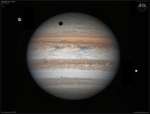 Ganymede s Shadow
25.03.2017
Approaching opposition early next month, Jupiter is offering some of its best telescopic views from planet Earth. On March 17, this impressively sharp image of the solar system's ruling gas giant was taken from a remote observatory in Chile.
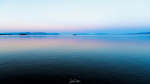 Shadow Rise on the Inside Passage
5.07.2018
At sunset look east not west. As Earth's dark shadow rises from the eastern horizon, faint and subtle colors will appear opposite the setting Sun. This beautiful evening sea and skyscape records the reflective scene from a cruise on the well-traveled Alaskan Inside Passage in the Pacific Northwest.
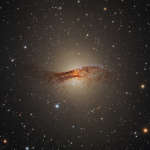 Centaurus A
12.07.2018
Only 11 million light-years away, Centaurus A is the closest active galaxy to planet Earth. Spanning over 60,000 light-years, the peculiar elliptical galaxy also known as NGC 5128, is featured in this sharp telescopic view.
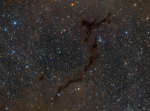 Barnard 150: Seahorse in Cepheus
25.10.2018
Light-years across, this suggestive shape known as the Seahorse Nebula appears in silhouette against a rich, luminous background of stars. Seen toward the royal northern constellation of Cepheus, the dusty, obscuring clouds are part of a Milky Way molecular cloud some 1,200 light-years distant.
 Apollo 11: Catching Some Sun
29.07.2023
Bright sunlight glints as long dark shadows mark this image of the surface of the Moon. It was taken fifty-four years ago, July 20, 1969, by Apollo 11 astronaut Neil Armstrong, the first to walk on the lunar surface. Pictured is the mission's lunar module, the Eagle, and spacesuited lunar module pilot Buzz Aldrin.
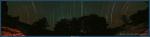 Night Trails of Africa
15.11.2002
Spanning southern to northern skies, stars trail across this panoramic view of the African night from equatorial Kenya. The three hour long exposure was made on a clear, dark, mid November evening facing due west and covers just over 180 degrees along the horizon.
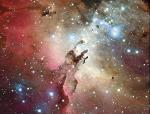 The Eagle Nebula from CFHT
13.02.2003
Bright blue stars are still forming in the dark pillars of the Eagle Nebula. Made famous by a picture from the Hubble Space Telescope in 1995, the Eagle Nebula shows the dramatic process of star formation. To the upper right of the nebula in the above picture lies the heart of the open cluster M16.
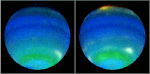 The Weather on Neptune
28.10.1996
Today's weather on Neptune will be typical. Highs in the upper atmosphere will be about -150 Centigrade, with winds ranging about 900 miles per hour near the equator. Much was learned recently about Neptune's weather by the release last week of time-lapse pictures of the most distant gas giant in our Solar System.
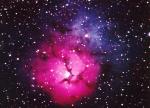 The Trifid Nebula in Red, White and Blue
8.12.1997
Three dark dust lanes give the picturesque Trifid Nebula its name. The red and blue colors of the Trifid Nebula are present in different regions and are created by different processes. A big bright star near the center of the red region appears white hot and emits light so energetic
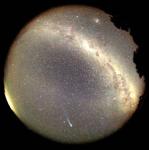 A Southern Sky View
26.02.1998
From horizon to horizon, the night sky above Loomberah, New South Wales, Australia was photographed by astronomer Gordon Garradd on March 22, 1996. Garradd used a home made all-sky camera with a fish-eye lens, resulting in a circular 200 degree field of view.
|
January February March April May June July August September |
|||||||||||||||||||||||||||||||||||||||||||||||||