
|
You entered: Galileo
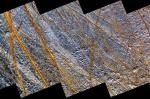 Plains and Ridges on Europa
14.12.1998
The ridges on Europa may be caused by cold water volcanoes. Europa, one of the largest moons of Jupiter, has been the source of intense scrutiny since speculation increased of there being oceans beneath its icy surface.
 Hammer Versus Feather on the Moon
1.11.2011
If you drop a hammer and a feather together, which reaches the ground first? On the Earth, it's the hammer, but is the reason only because of air resistance? Scientists even before Galileo have pondered and tested this simple experiment and felt that without air resistance, all objects would fall the same way.
 Oceans Under Jupiter's Europa?
9.04.1997
Is there life beneath Europa? Today, new results are being announced (at about 2 pm EST) about the possibility of oceans under Jupiter's moon Europa. The existence of such oceans increases the likelihood that some sort of life exists beneath the fractured ice planes of Jupiter's smoothest satellite.
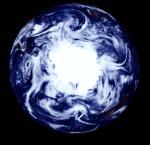 Summer at the South Pole
22.12.2000
The December solstice brings the beginning of Winter to Earth's Northern Hemisphere and Summer time to the South! This view of Earth's Southern Hemisphere near the beginning of Summer was created using images from the Galileo spacecraft taken during its December 1990 flyby of our fair planet.
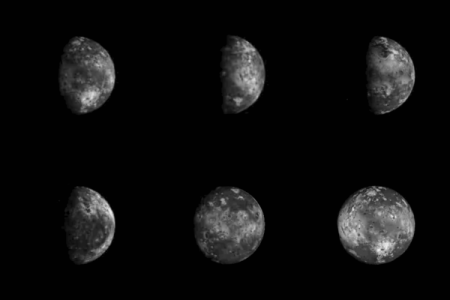 Io Rotating
30.12.1996
Are any volcanoes on Io currently erupting? To help answer this, scientists instructed the robot spacecraft Galileo to take hourly pictures of this moon of Jupiter prior to its most recent encounter. The most obvious changes in Io are due to the changing amount of sunlight reflected from the moon to the spacecraft.
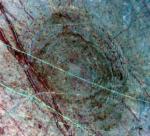 Impact on Europa
15.08.1997
This bull's-eye pattern marks the impact of a mountain-sized comet or asteroid on the icy surface of Jupiter's moon Europa. Recorded by the Galileo spacecraft in April of this year, the composite false color image clearly reveals the telltale concentric fractures which cover about
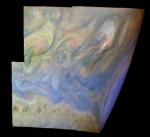 West Of The Great Red Spot
25.12.1997
The turbulent region West of Jupiter's Great Red Spot is highlighted in this recent picture constructed from data recorded by the Galileo spacecraft. The image is color coded to show cloud height and thickness; white clouds are high and thick, light blue clouds are high and thin, and reddish clouds are low.
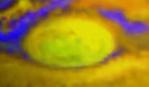 Jupiter: The Great Yellow Spot
10.03.1997
What happened to Jupiter's Great Red Spot? Operating at a chilly 55 degrees Kelvin, the Galileo Spacecraft's Near Infrared Mapping Spectrometer (NIMS) recorded this composite image of Jupiter's Great Red Spot in late June 1996.
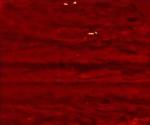 Night Lightning on Jupiter
15.12.1997
Why is there lightning on Jupiter? Lightning is a sudden rush of electrically charged particles from one location to another. To create lightning, charges must first separate inside a cloud. On Earth, drafts of colliding ice and water droplets usually create this charge separation, but what happens on Jupiter?
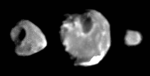 Jupiters Moons Thebe, Amalthea, and Metis
8.05.2000
The robot spacecraft Galileo in orbit around Jupiter has recently photographed the inner moons of Jupiter in greater detail than ever before. These pictures of Thebe, Amalthea, and Metis are shown to scale, and reveal details as small as three kilometers across. Amalthea, by contrast, has a total length of about 200 kilometers.
|
January February March April May June July August September October |
|||||||||||||||||||||||||||||||||||||||||||||||||