
|
You entered: Galileo
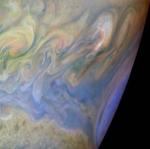 West Of The Great Red Spot
26.12.1999
The turbulent region West of Jupiter's Great Red Spot is highlighted in this picture constructed from data recorded by the Galileo spacecraft. The image is color coded to show cloud height and thickness; white clouds are high and thick, light blue clouds are high and thin, and reddish clouds are low.
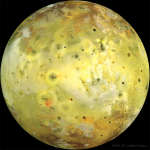 Io in True Color
11.12.2022
The strangest moon in the Solar System is bright yellow. The featured picture, an attempt to show how Io would appear in the "true colors" perceptible to the average human eye, was taken in 1999 July by the Galileo spacecraft that orbited Jupiter from 1995 to 2003.
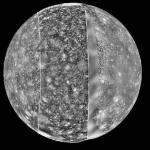 Callisto Full Face
9.12.1996
Callisto's surface shows its age. While probably formed at the same time as Io, the difference between the surfaces of these two moons of Jupiter could hardly be greater. Io's surface is young, shows practically no impact craters, and is continually being repaved by the lava exploding from its many large volcanoes.
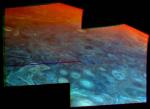 Hazing Jupiter
9.01.1997
A dramatic mosaic of recent images from the Galileo spacecraft reveals details of swirling clouds and a thick stratospheric haze in the atmosphere of Jupiter, the Solar System's largest planet. This false color...
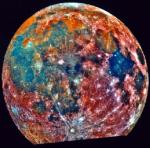 The Colorful Moon
7.01.1998
Do you recognize the Earth's Moon when you see it? The crazy, patchwork appearance of this false color image makes this nearly full view of our Moon's familiar nearside look very strange. The image was taken in 1992 by the Galileo spacecraft enroute to Jupiter.
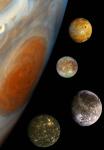 Jupiter And Family
29.09.1997
This composite image features classic portraits of members of one of the Solar System's most prominent families - Jupiter and its four large "Galilean" moons. Starting from the top the moons are Io, Europa, Ganymede, and Callisto. The top-to-bottom order is also the order of increasing distance from Jupiter.
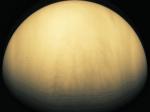 Venus: Earths Cloudy Twin
16.05.2004
This picture by the Galileo spacecraft shows just how cloudy Venus is. Venus is very similar to Earth in size and mass - and so is sometimes referred to as Earth's sister planet - but Venus has a quite different climate.
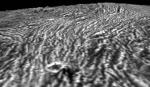 Oceans Under Jupiter's Ganymede
18.12.2000
The search for extraterrestrial life came back into our own Solar System last week with the announcement that there may be liquid oceans under the surface of Jupiter's moon Ganymede. Ganymede now joins Callisto and Europa as moons of Jupiter that may harbor seas of liquid water under layers of surface ice.
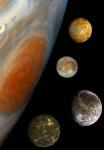 Jupiter And Family
18.11.2000
This composite image features classic portraits of members of one of the Solar System's most prominent families - Jupiter and its four large "Galilean" moons. Starting from the top the moons are Io, Europa, Ganymede, and Callisto. The top-to-bottom order is also the order of increasing distance from Jupiter.
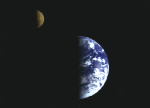 The Earth-Moon System
29.06.1995
A double planet? From 4 million miles away on December 16, 1992, NASA's robot spacecraft Galileo took this picture of the Earth-moon system. The bright, sunlit half of the Earth contrasts strongly with the darker subdued colors of the moon. Our moon is one of the largest moons in the solar system.
|
January February March April May June July August September October |
|||||||||||||||||||||||||||||||||||||||||||||||||